You paid for white. You are wearing grey.
It took about a week. You stepped off the footpath near Dak Bungalow, an auto went through the puddle beside you, and what landed on your canvas was not water. You wiped it with a wet cloth. It smeared. By August the shoes were the colour of the road, and somewhere along the way you started calling them your outside shoes, which is a polite way of saying you gave up on them.
Patna dirt is fine, and that is the problem
There are two kinds of dirt in this city, one per season.
From April the dirt is dust. Dry, fine, weightless. It does not sit on top of canvas waiting to be brushed away. It goes into the weave and parks between the fibres, and the shoe looks dull rather than dirty, so you never think to wash it.
From July it is silt. The mud that comes up off Ashok Rajpath after a good downpour is clay ground down to a powder, mixed with drain water. Wet clay that fine behaves like a dye. Put water on it and rub, and you are not cleaning your shoe. You are painting it.
This is why the wet cloth makes it worse. You are pressing clay into cotton with your own thumb.
Three things almost everyone does wrong
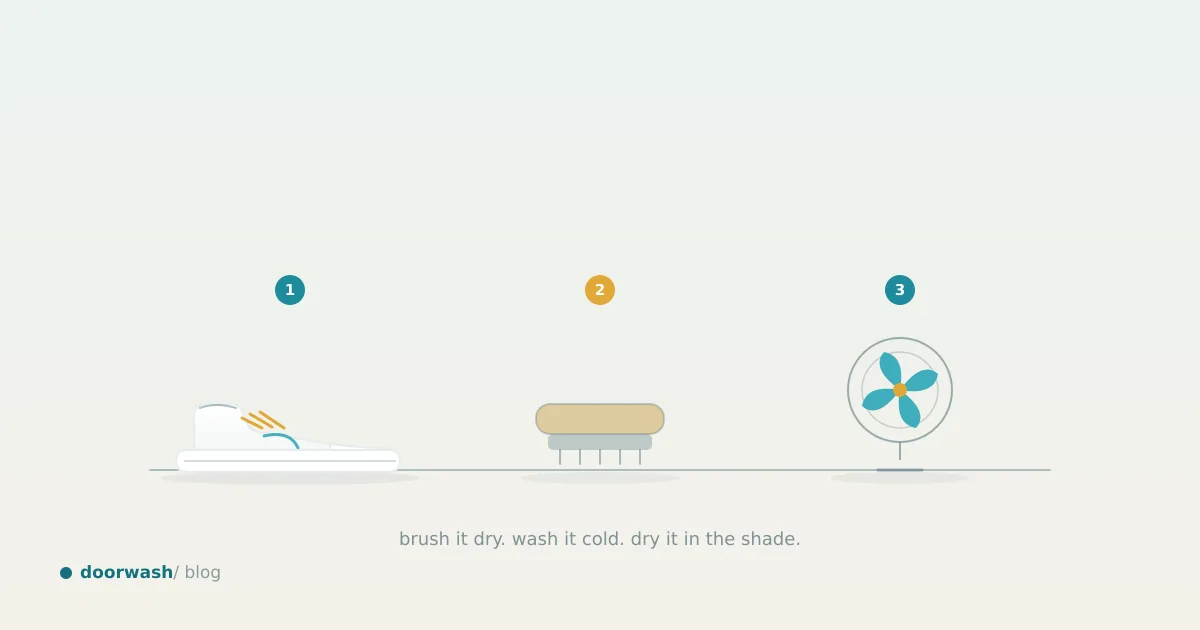
Touching it while it is wet. Let the mud dry all the way. Then take a dry brush and knock it off across the weave, not into it. Most of it leaves as powder and never touches water at all. Water comes second. Never first.
The washing machine. A shoe is a hard object. The drum will throw it against a steel wall a few hundred times, and the glue holding the midsole to the upper does not enjoy that. Neither do the eyelets, and neither does the machine. Shoes come out of a wash looking clean and aging twice as fast. Six weeks later the seam at the toe lifts and you decide the brand cheated you.
Drying them on the terrace at two in the afternoon. A May sun in Patna is not a dryer. It is a bleach. Ultraviolet light turns white rubber a permanent deep yellow that no brush is ever getting back, and the heat softens the adhesive under the sole. Shade and moving air. Every single time.
The smell is not in the shoe
Pull the insole out. Smell the insole, then smell the empty shoe. The shoe is fine.
That insole is a foam sponge that has quietly absorbed a few litres of your sweat, and it is now the most alive thing you own. Scrub the outside of the shoe as long as you like. The smell stays exactly where it was.
Insoles come out and get washed on their own. Cold water, mild detergent, squeeze, dry flat in shade. Laces come out too. Grey laces make a clean shoe look dirty, and everybody looks at the laces without knowing they are looking at them.
Doing it properly, once
Cold water, not warm. Warm water sets sweat and skin protein into fabric and softens glue while it is at it.
Soft brush for the panels, an old toothbrush for the seams and the stitching around the toe. A small amount of mild detergent, foamed on a cloth, worked into one section at a time and wiped off before it dries. If there is leather or suede anywhere on the shoe, it never goes underwater.
Then stuff them with newspaper, change the paper once when it turns damp, and stand them in front of a fan in a shaded room. In July, give it two full days. They will not be dry on the morning you need them. Plan for that or do not start.
The honest arithmetic
Forty minutes on your knees on a wet bathroom floor. Two days with no shoes. And a decent chance that after all of it the midsole comes up white while the toe cap stays grey, because that grey is clay pressed into cotton and a toothbrush is losing that fight.
So here is what actually happens instead. You own one pair you genuinely like. You wear them four days a week. You have not cleaned them properly in fourteen months, because every time you look at the job you decide next Sunday is a better Sunday.
Meanwhile the dirt is not idle. Silt is abrasive. It works between the fibres every time the shoe flexes and cuts them from the inside, which is why old canvas goes soft and thin at the crease across the toe. The shoe is not dying of age. It is being sanded down from within by the road.
Send them out
We clean shoes. We come to your door in Patna, take them, and bring them back.
Insoles and laces get treated separately, because they have to be. The uppers get worked by hand, not thrown in a drum. They dry in moving air, indoors, so the rubber stays white and the sole stays attached. You do not lose a Sunday and you do not lose the shoes.
The pair you like should be the pair you wear. Not the pair in the box, kept clean for an occasion that keeps not arriving. Wear the good shoes on a Tuesday. That is what they are for.