You bought it two winters ago, from a stall near Hathwa Market or out of a courier bag. It was fat and warm and it got you through January on a scooter down Bailey Road at seven in the morning, fog so thick you could not see the signal.
Then in March you washed it.
You put it in the bucket with a scoop of powder, pressed it down, scrubbed the collar, wrung it out hard and hung it on the terrace line. A week later you pulled it off. The top half was a flat sheet of nylon. The bottom of every pocket of stuffing held a hard little lump. It still looks like a jacket. It is not warm anymore.
Nothing was wrong with the jacket. The wash was wrong.
What is inside the jacket
A puffer is two thin layers of nylon with loose filling sewn between them in channels. The filling is either down, which is the soft under-feathers of a duck or goose, or polyester fibre made to behave like down. Cheaper jackets use polyester. Expensive ones use down. Both work the same way.
The filling is not warm by itself. The air trapped inside it is. Fluffy filling holds a lot of air. Flat filling holds almost none. That fluff has a name, loft, and everything you do to a puffer either protects it or kills it.
Water kills loft for a while. Wet filling collapses and sticks to itself. That is normal. The trouble starts when it dries in the collapsed shape.
Where the bucket goes wrong
Three things happen in the usual Patna wash.
The powder stays behind. Detergent powder does not fully dissolve in cold bucket water, and a puffer has hundreds of tiny pockets for it to hide in. You cannot rinse it out of filling the way you rinse it out of a shirt. The leftover powder glues fibres together. Those are your lumps.
The wringing crushes it. Twisting a wet puffer packs the filling into the seams, and some of the stitch holes tear wider. That is how feathers start poking out of a jacket that never leaked before.
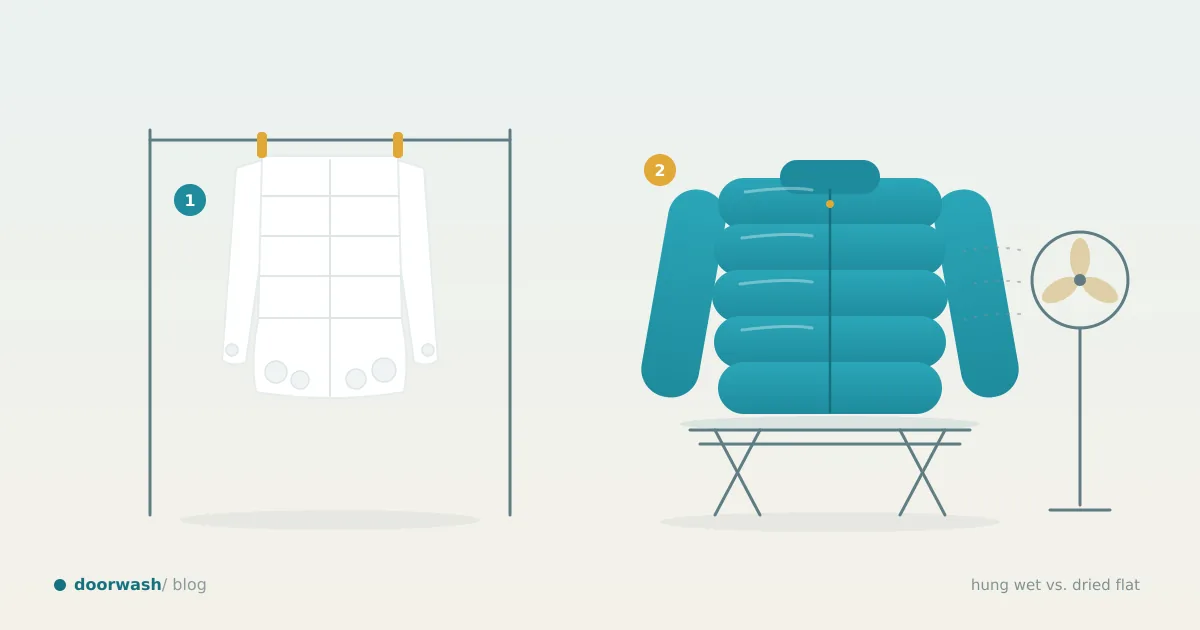
The line pulls it down. Hang a wet puffer by the shoulders and gravity does the rest. All the wet filling slides to the bottom of each channel and dries there. Top empty, bottom solid.
How to wash it properly
Read the tag first. If it says dry clean only, listen to it. Most say hand wash or gentle machine wash.
Close every zip and every press button. Empty the pockets. Turn it inside out.
Use liquid detergent, and use very little. One small capful for the whole jacket. If you only have powder, dissolve it fully in a mug of warm water before it goes anywhere near the jacket.
In a bucket, use lukewarm water. Press the jacket down gently and let it sit for twenty minutes. Squeeze, do not scrub. The collar and the cuffs are the dirty parts. Hair oil and neck sweat live there. Work those with your fingers and a little extra liquid detergent.
Rinse twice. Then a third time. When you press the jacket and no foam comes out, you are done.
To get water out, roll it in a dry towel and press. Do not twist it. Not once.
A front-loading machine on a gentle cycle is fine. A top loader with a tall centre pole will beat the jacket against it. Use the bucket.
How to dry it in Patna
This is the part that takes time, and in Patna it takes longer than anywhere you have read about.
Lay the jacket flat. A folding drying stand with a towel over the bars works. A clean charpai works better. Keep it in shade with moving air. A room with the fan on is good.
Every three or four hours, pick it up and shake it. Break up any clumps you feel with your fingers. Pat it like a pillow. This is what puts the air back in.
It will take two to three days. Do not give up on day one because the outside feels dry. The filling dries last, and damp filling grows mould and smells like a wet dog by the next winter.
Avoid the January sun. Foggy Patna mornings give you three or four weak hours of sunlight, which is enough to dry the shell and not enough to dry the inside. Nylon also fades under strong sun, so a dark jacket left on the roof will go patchy.
If a building near you has a tumble dryer, use it on low heat with two clean tennis balls inside. The balls bounce against the jacket and break up the clumps for you.
When to wash it
Not often. Once a season is enough for most people. Twice if you ride a scooter every day and the collar has gone shiny.
Wash it at the end of winter, before you put it away. Dirty filling stored through the Patna monsoon comes out in November smelling of the almirah. Store it loose in a cotton bag, not squeezed into a vacuum pack. Months of crushing flatten filling too.
You only need to get it right once
A good puffer lasts ten winters. A badly washed one lasts two. The difference is a capful of liquid instead of a scoop of powder, a towel instead of your fists, and three days of patience on a stand.
If three days of shaking a jacket every few hours does not fit your life, hand it to us. DoorWash picks it up from your door, washes it gently, dries it properly and brings it back fat and warm. Just in time for the fog.