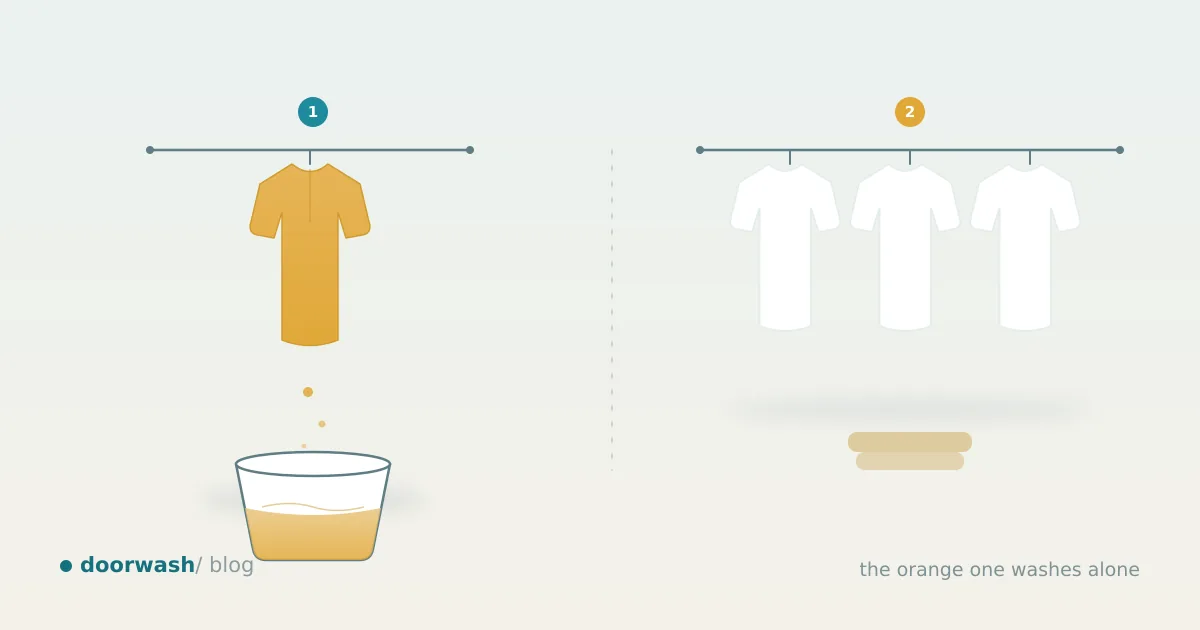
You bought it two days before the first Somwar. Kesariya kurta, kesariya gamcha, three hundred rupees from a cart near Patna Junction. Dry, on the cart, it looked wonderful.
Then you washed it.
Now the bucket water is orange. Your palms are orange. And the white baniyan that was soaking in there with it has turned a sad, uneven peach that is never coming back.
This happens every Sawan, in every mohalla, to somebody.
The colour was never really attached
There are two ways to put orange on cotton.
The good way uses a reactive dye. It forms an actual chemical bond with the cotton fibre. It costs more, takes longer, needs a proper fixing and rinsing step at the mill.
The cheap way uses a direct dye. One bath, fast, done. The dye holds on by weak attraction, the way dust holds on to a wall. Nothing is bonded. A serious amount of it is just sitting loose on the surface of the cloth waiting for water.
Festival clothes are made in a hurry, sold at a price, and worn for four Mondays. Guess which way they get dyed.
So the orange coming off your kurta is not a defect. It is the part of the dye that was never fixed in the first place. Your first wash is finishing a job the factory skipped.
The bucket is where the damage happens
The Patna habit is to fill a bucket, throw in the powder, throw in everything, and leave it for an hour while you have chai and read the paper.
That hour is the problem.
Loose dye comes off fastest in warm water, in alkaline detergent, over time. All three are sitting in your bucket. And the dye that comes off does not politely stay in the water. Cotton pulls it back in. Your white shirt spends sixty minutes drinking orange, and on the second wash that colour is no longer loose. It has settled in.
Soaking is what turns a bleeding kurta into a ruined shirt.
What actually works
Wash it alone. Not with the whites, not with the light colours, not with the towel. Alone, for the first four or five washes.
Use cold water. Actually cold from the tap, not the bucket that has been standing on the terrace since noon.
Do not soak it. In, twenty minutes, out.
Use less detergent, and a mild one. Strong alkaline powder strips more dye off the cloth.
Rinse until the water runs clear. If the third rinse is still tinted, it is still bleeding, and you are not done.
Do not leave it balled up wet in a bucket or a bag. Wet cloth pressed against wet cloth transfers colour to itself, and you will find orange on the inside of the sleeve where nobody expected it.
Someone will tell you to add salt. Salt helps dye enter cotton in a hot dyebath at the mill, with the right chemistry and the right time. It does nothing for a finished kurta in your bathroom. Vinegar is the same story. Vinegar helps set acid dyes on wool and silk. Your cotton kurta does not care.
There is one honest test. Wet a corner of the kurta, press a scrap of white cloth against it for thirty seconds, and look at the white. That is exactly what your other clothes are going to look like.
The sun will eat the colour anyway
Saffron and orange fade faster in sunlight than almost anything else you own.
Hang that kurta on the terrace in Kankarbagh at one in the afternoon and by the third Somwar it is apricot. Not bright. Not the colour you bought.
Dry it inside out, in shade, with air moving. In a Sawan week that means indoors under a fan, spread wide, never folded double over the line. Cloth folded over a line in Patna humidity stays wet in the crease for hours, and that is where the smell starts.
If you are walking to Deoghar
Sultanganj to Deoghar is about a hundred and five kilometres, barefoot, in the rain, over four days. The same clothes the whole way.
Sweat is salty and slightly acidic. It lifts loose dye off the kurta and moves it onto your skin, your bag strap, and every white thing that touches you. That is why your shoulder is orange by the second night.
Carry a spare set. Not for comfort. So one set is drying while the other is on you.
When you get home, keep the yatra clothes out of the family wash. They carry road silt along with the dye, and silt is abrasive. Rinse them alone in cold water first, twice, then wash them alone.
The white shirt that already got hit
If a white garment has picked up orange, act while it is still wet.
Do not iron it. Do not dry it in the sun. Heat is what makes a stray dye stain permanent.
Rewash it immediately in cold water with oxygen bleach, the sodium percarbonate kind you get as a whitening powder. Repeat it. Two gentle rounds beat one violent one. Keep chlorine bleach away from it, because chlorine reacts badly with some dyes and can leave you with a yellow shirt instead of an orange one.
If it has already been dried and pressed, be honest with yourself. It is a house shirt now.
Sawan is four Mondays and then it is over. The kurta should last longer than that.
If running a separate cold bucket for one kurta is not how you want to spend Monday evening, send it to us. We wash colour like that on its own, cold, and it never sees your whites.