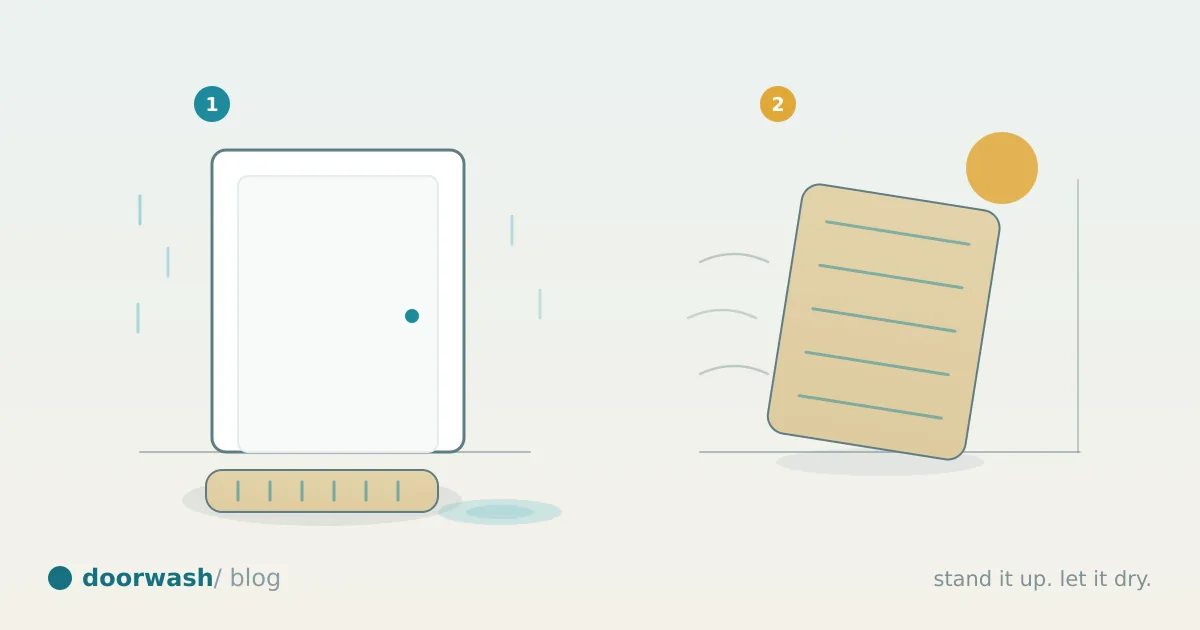
Go and look at the mat outside your door.
Not later. Now.
It has been lying there since the rains started in June. Every person who came to your house in the last two months wiped their feet on it. The milk man at six in the morning. The delivery boy. Your neighbour's kid. You, four times a day, walking in from a lane with water standing in it.
Nobody has washed it once.
The lane comes in on that mat
Road water in Patna in August is not rain water. By the time it reaches your gate in Kankarbagh or off Boring Road, it has mixed with whatever came up out of the drain. Silt, sewage, cow dung from the corner, engine oil, rotting sabzi from the thela.
Your chappal walks through it. Then you scrape the chappal on the mat. That is the mat doing its job.
The problem is what the mat does after that. It keeps everything. Coir traps grit deep in the fibre. A cotton mat drinks the water like a towel. Your shirt gets washed the same night it gets dirty. The mat gets nothing.
Then your kid sits on the floor three feet away. Your mother spreads a cloth near the door for puja. You walk in barefoot at night. The mat is the busiest piece of cloth in your house and the only one nobody has a plan for.
It never gets a chance to dry
A shirt on the terrace line has air on both sides. A mat has air on one side. The underside lies flat against your tile with nothing moving through it.
Add the Patna August air. Humidity sits near ninety percent most mornings. There is no dryness in the air to pull water out of anything. So the mat stays half wet, and half wet is the exact condition mould wants.
Lift your mat right now. Look at the floor under it. A dark patch, a grey ring, a smell like a bathroom nobody uses. That growth has been there since June.
Rubber-backed mats are the worst of the lot. The backing seals the bottom completely. Water goes in from the top and has nowhere to leave from. The mat looks fine and smells like a pond.
Beat it before you wet it
This is the part people get backwards. They see a muddy mat, so they throw a bucket of water on it. Now the mud is a paste, and the paste goes deeper into the fibre.
Dry first, always.
Carry the mat to the terrace. Hang it over the railing. Hit it with a broom handle or a stick, both sides, until nothing more falls out. What comes off is going to surprise you. That is two months of Patna in a cloud.
Then wash by type.
Cotton or microfibre mat. Machine, warm water, on its own. Never with your clothes. Putting drain-water mud in the same drum as your office shirts is a bad trade. Skip the fabric softener. It coats the fibre and kills the grip you actually bought the mat for.
Rubber-backed mat. Cold or lukewarm water only, gentle cycle or a hand wash. Hot water cracks the backing. Once it cracks, it starts shedding black crumbs across your floor for the rest of its life, and no wash fixes that.
Coir mat. It does not go in a machine. Brush it hard while it is dry, then take it to the tap with a stiff brush and a little detergent. Rinse until the water running off is clear. Coir holds soap and soap holds dirt.
Drying is the whole game
Do not lay it flat on the terrace. You will repeat the same mistake that made it smell in the first place. The top dries, the bottom stays wet, and you carry it back downstairs still damp inside.
Stand it up. Over a railing, on a line, leaning against a wall on its edge. Air on both faces.
Before you put it back at the door, press your palm into the middle of it. Cool means wet. Wait longer.
Two mats and ten seconds a night
Buy a second mat. They cost a couple of hundred rupees at Hathwa Market. One at the door, one clean and dry in the almirah. During monsoon you swap them every week and neither one lives a permanent wet life.
Then there is the ten second habit. Every night before you sleep, lift the mat and stand it against the wall next to the door. The floor underneath gets to dry. The mat gets air on its underside for the first time all day. In the morning you put it back.
Ten seconds. It will do more for that mat than any detergent you buy.
Once a week through the monsoon. Every two or three weeks the rest of the year. Write it on the same day you change your bedsheet so you do not have to remember a second thing.
And if the terrace is full and the rain has not stopped for three days, send it with your laundry. We pick up from your door. The mat is right there.