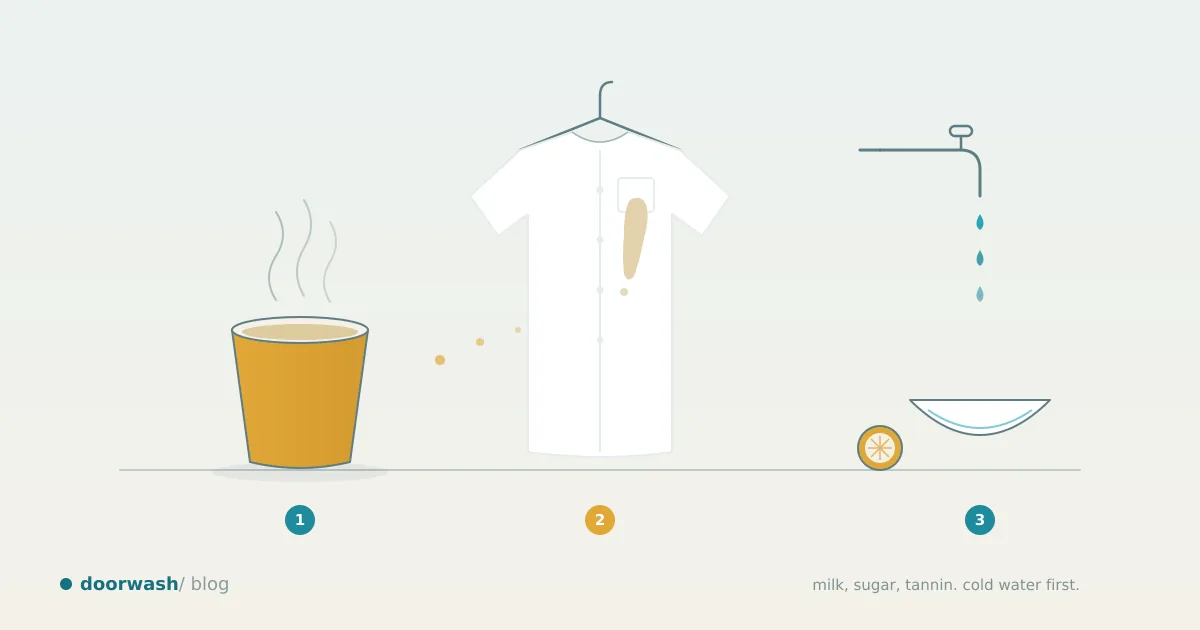
It happens around half past four. You're standing at the tea stall outside your office on Boring Road, or at a corner of Ashok Rajpath with two friends from the hostel. The kulhad is too hot to hold properly. Someone knocks your elbow. A brown line runs down your shirt from the pocket to the second button.
You dab it with a tissue. The tissue turns brown. So does the stain, a little more.
You forget about it until night. By then, it has become a different stain.
What's actually in the cup
Patna chai is milk boiled with tea leaves, a lot of sugar, sometimes adrak, sometimes elaichi, until it turns the colour of a wet brick. That one cup leaves three kinds of mess on your shirt. Each one behaves differently.
Tannin. This is the brown. It comes from the tea leaves, and it is a dye. The same family of compounds was used for centuries to tan leather. It grabs cotton fibres and holds on.
Milk. The fat leaves a faint greasy ring. The protein settles into the weave. Heat cooks protein. You have seen this at the bottom of every patila that boiled over.
Sugar. Invisible while it's wet. It dries clear and slightly stiff. When it meets heat, it goes brown, exactly like it does in a kadhai.
Treat all three as one stain and you'll clear one of them while you lock in the other two.
The three things everyone does
Hot water
Hot water feels like the serious option. For milk, it's the worst one. It cooks the protein into the fibres, and now the tannin has something to cling to. You've given the stain a skeleton.
The bar soap
Next comes the washing bar, rubbed hard into the spot. Bar soap is alkaline, and tannin stains darken when they meet alkali. Watch closely and you'll see a light brown mark turn into a duller, deeper tan. That's the soap setting it. The scrubbing also roughs up the fibres, so the patch looks faded and fuzzy even if some colour lifts.
The iron
This one does the real damage. After one wash, the mark looks almost gone. It's Monday, you're late, you iron the shirt. The shadow you could barely see turns into a hard yellow-brown outline. That's leftover sugar caramelising and leftover milk cooking, right there under the plate. Once that happens, you're fighting something close to permanent.
What to do instead
The order matters more than the products.
- Rinse it cold, from the back. Turn the cloth inside out and run water through the stain from behind, so the chai leaves the way it came in. Don't rub. If you're still at the stall, a glass of drinking water poured through from the inside of the shirt is enough.
- Soak in cold water for thirty minutes. Sugar dissolves easily in cold water. Let it go first.
- Liquid detergent, worked in with a fingertip. Most liquid detergents carry enzymes that break down protein. Leave it on for ten minutes. Rinse.
- Then go after the brown with mild acid. Squeeze half a lemon over the spot, or mix a spoon of white vinegar into a mug of water and dab it on. Wait fifteen minutes, rinse. On a white cotton shirt, an hour on the terrace in the October sun helps the lemon finish the job.
- Check it wet, in daylight. Wet cloth hides nothing. Any shadow you see now will come back brown under the iron. If you see one, repeat step four.
Only iron it once the wet check comes up clean. Every time.
The cloth matters
White cotton forgives you the most. The steps above will clear a fresh chai spill from a cotton office shirt nearly every time.
Khadi is harder. The loose, thick weave drinks the chai deep, so give it a longer cold soak.
Polyester, like most school uniforms, holds on to milk fat. Spend more time on the detergent step and less on the lemon.
Silk is a different story. A Bhagalpuri tussar kurta, a saree with zari, anything you'd be upset to lose: don't experiment with lemon or vinegar. Blot it, keep it flat, and get it to someone who handles silk for a living. Same day if you can manage it.
The rings you already have
Open your almirah and look at the right cuff of your office shirts. Many of them will have a pale brown band just inside the edge. That's the cuff dragging across a desk that has seen a few hundred glasses of chai.
None of those marks happened in one day. Each one was a small spill, washed hot, ironed on a Monday morning, and then spilled on again. Layer over layer.
They can still be lightened. A long cold soak, liquid detergent, and two or three rounds of lemon will pull back a lot of that colour. It's slow. Thirty seconds under a cold tap at the time is faster than any of it.
When you hand it to us
If a shirt in your DoorWash bag has a chai mark, point it out when we pick up. Tell us it's chai, and tell us whether it's been ironed since. Those two facts decide what we treat first and what we keep away from heat until the stain is out.
Drink your chai. Just keep the iron away from the spill.