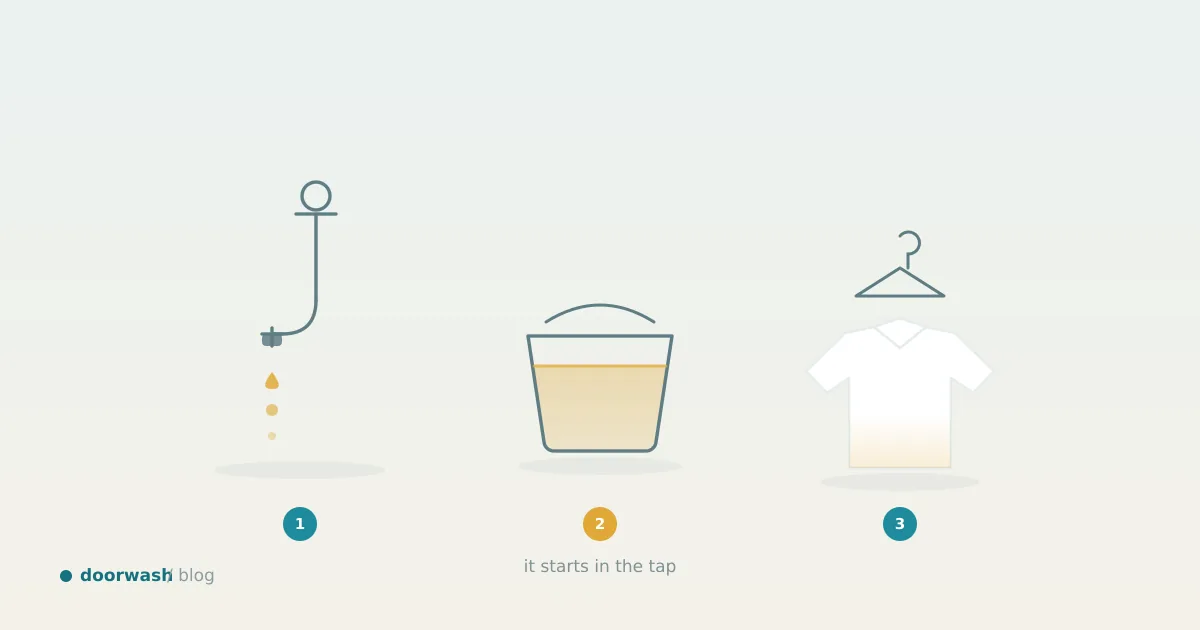
Go look at your bathroom bucket. The white one.
There is an orange ring inside it, around the waterline. You have scrubbed it with Vim. It faded and it came back.
That is not dirt. That is iron, and it came out of your tap.
Patna is sitting on iron
This city runs on boring water. Motor on at six, water up to the tank on the roof, tank feeds your bathroom for the rest of the day. Kankarbagh, Rajendra Nagar, Patliputra, Rukanpura, Anisabad. Same arrangement in every one of them.
The ground under this city is Gangetic silt and that silt is heavy with iron. Your water sits in it. It picks it up.
Dissolved iron is invisible. Straight from the tap the water looks clean, and it is clean enough to drink after boiling, which is why nobody suspects it.
Try this once. Fill a bucket, leave it, come back after an hour. There is a thin film on the surface that breaks into colours when you touch it, the way a drop of diesel does on a puddle. There is fine orange silt sitting at the bottom. Nothing fell in. The iron met the air and turned solid.
Now picture that happening in a bucket with your clothes in it.
What it does to cotton
The iron goes into the fibre and rusts there. Not on the cloth. In it.
You will not catch it the first time. You catch it after a year, when your white ganji is the colour of weak tea and your son's school shirt has gone the same shade as the wall behind his bed. The colour is perfectly even, top to bottom, sleeve to sleeve. That evenness is why you blame the detergent. Dirt is never even. Iron is.
Hardness rides along with the iron. The calcium in Patna water grabs your detergent before it reaches the cloth and turns it into a scum that will not rinse out. Your towel going scratchy by the fourth month is that scum drying inside the weave.
The thing that makes it permanent
The whites look dull, so you reach for bleach. Ala, bleaching powder, whatever the kirana had on the shelf.
Don't.
Chlorine bleach is an oxidiser. The iron in your cloth is sitting there waiting to be oxidised. You pour bleach on it and you finish the reaction with your own hands. Pale yellow becomes orange-brown, and at that point it is locked in. That is the stage at which people bring us a shirt and ask us to save it. Mostly we can't.
Hot water does the same job, slower.
What actually lifts it
Acid. Iron lets go of cotton in acid.
Citric acid, sold in every kirana here as tatri or nimbu ka phool, ten rupees a packet. Two spoons into a bucket of water. Whites go in for twenty minutes, not longer. Rinse twice, properly, then dry in the sun.
Nimbu and salt works on one patch, one collar. For a full bucket it is weaker and it costs more.
Do it before the wash, never after. Detergent is alkaline. Acid and alkali cancel each other out and you have wasted an evening.
Three things that cost you nothing
Let the tap run thirty seconds before you fill a bucket for washing. The first push after the motor starts carries whatever settled inside the pipe overnight, and that is the worst water of the day.
Get the tank cleaned once a year. Climb up and open it first, so you know what you are dealing with. The floor of an uncleaned tank in this city is orange sludge, and every wash you have done this year pulled from it.
Wring and hang immediately. A washed heap sitting in a bucket while you finish your tea is still soaking in the same water, and iron keeps moving into cloth for as long as the cloth stays wet.
The honest part
None of this fixes your water. It manages it.
A candle filter on the tank line catches particles. Dissolved iron goes straight through and it is dissolved iron that stains. Real removal means aeration and a proper media filter, and nobody is installing that on the roof of a rented 1BHK off Boring Road.
That is our half of the job. Water at our plant is treated before a garment touches it, which is the whole reason a shirt comes back from us a shade lighter than it went. There is no trick in the detergent. It is the water.
Go look at that bucket again. That colour has been going into everything you own, one wash at a time, for as long as you have lived here.