You own two aprons. You wear one.
The other is in a bucket, or in a bag, or under a pile on your trunk. So the one on your shoulders has done the medicine ward, the canteen, the library, a shared auto down Ashok Rajpath, and then your hostel room. Where you sat down on your bed in it.
That last part is the one worth thinking about.
White was a decision
Somebody chose white for doctors so that dirt would have nowhere to hide. It works. A white apron is honest about itself.
Yours is not white. Hold your cuff against a fresh sheet of A4 and look. That grey is real, and it took about eleven days.
The dirt lives at the ends
The chest of your apron is mostly fine. You do not press your chest into things.
Your cuffs do. They land on bed rails, trolley handles, dressing trays, the edge of a mattress, the back of a chair in the OPD corridor. Every time you reach for something, the sleeve arrives before your hand does. Everyone who has ever tested a white coat has found the same two places carrying the most: the sleeve ends and the pockets.
The pocket is worse. Into it goes a pen, your phone, a folded ECG strip, a torch, hostel keys, a stethoscope that has been on forty chests since eight in the morning. Your hand goes in and out of that pocket two hundred times a day. Nothing in there has ever been cleaned.
Then you hang the apron on the nail behind your door. The same nail as your towel.
You are not lazy. You are stuck.
Here is the arithmetic nobody says out loud.
It is September in Patna. Humidity sits above eighty percent most mornings. Wash an apron at nine at night, hang it across your hostel room, and at nine the next morning it is still cold and damp at the seams, with that sour smell that means it dried too slowly. Two aprons, one wet, and you have nothing for rounds.
So you wear yesterday's. Then Tuesday's. And you tell yourself it still looks clean, which is only a way of saying you have stopped checking.
Winter is no better. A December morning here has fog until ten. Nothing dries then either.
Blood and betadine
Cold water on blood. Only cold. Hot water cooks the protein into the cotton and sets it, and then you have a brown ghost on your left sleeve for the rest of the coat's life. Get it under a cold tap the same day. Not tomorrow morning.
Betadine is iodine. It looks permanent and it is not, but scrubbing is the wrong move. Scrubbing turns a small dark stain into a big pale one. Rinse it cold, leave it, let it lift. Iodine fades on its own more than you expect.
The rule for both is speed, not force. An hour matters more than an arm.
Bleach will finish your apron
Everybody's first idea is bleach. Pour it in, get the white back.
It works twice. On the third wash the fabric starts telling you something. Your apron is a polyester and cotton blend, and chlorine bleach reacts with polyester and turns it permanently yellow, usually at the collar and the fold lines first. It also thins the fibre. That is why aprons split at the pocket seam in January when they were fine in October.
The yellow you are now trying to bleach out is the yellow the bleach put in.
What to actually do
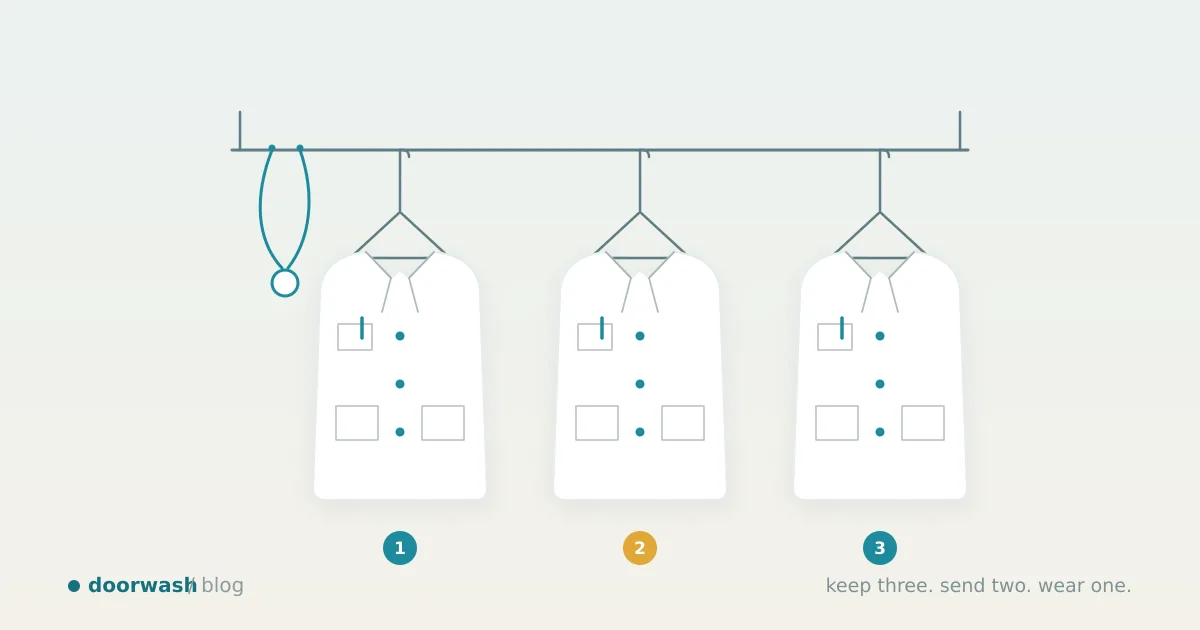
Own three, not two. Three is the number that makes weekly washing physically possible, and a third apron costs less than one bad week.
Wash it alone or with other whites. Never with your bedsheet. You do not want the ward and your pillow in the same bucket.
Once a week is the floor. If you are on a ward posting, make it every three days.
Take it off at the door of your room and hang it away from your towel. It has no business touching your bed, and it certainly has no business in the mess at lunch.
And get it pressed. A limp apron reads as a careless doctor to every patient who sees you, and they are reading you from the moment you walk in.
The part we do
We pick up from hostel gates in Patna and bring the clothes back washed, dried properly, and pressed. Properly dried means machine dried, which is the only thing that beats a Patna September. Your apron comes back white, flat, and dry all the way through the seams.
You are doing hundred-hour weeks. Losing an evening to a bucket is not devotion. It is just a lost evening.
Keep three. Send two. Wear one.