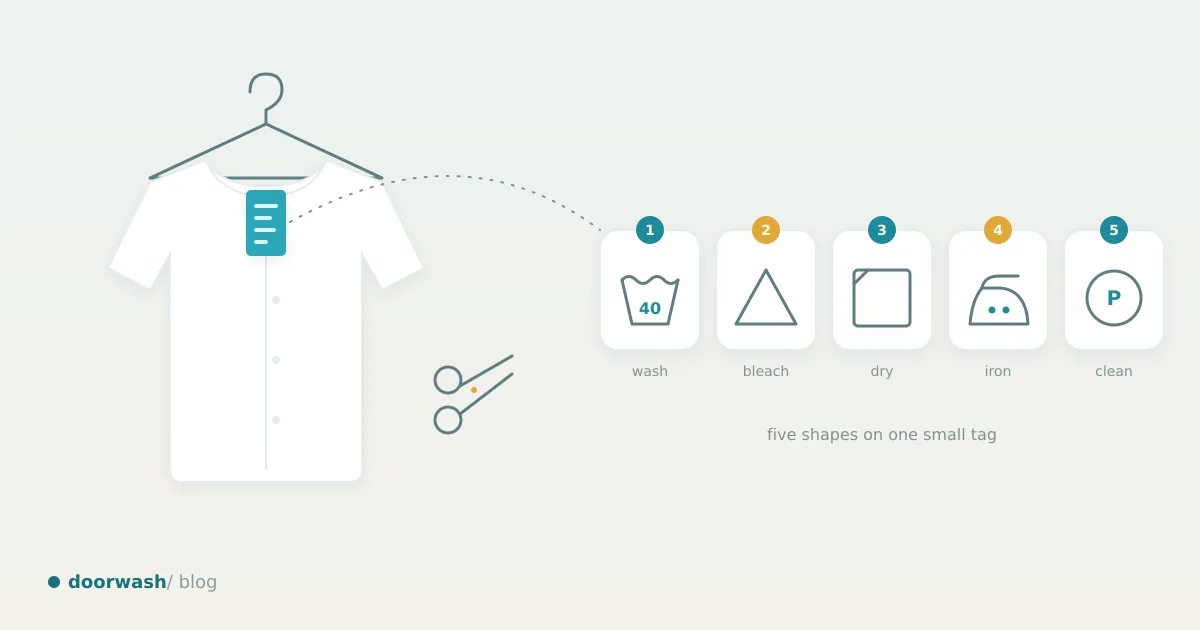
You bought a shirt at Hathwa Market. You wore it once. The little white tag at the back of the neck scratched you all day, so that night you took the kitchen scissors and cut it off.
That tag was the only manual the shirt came with.
Everything the factory knew about that fabric was printed on it. The temperature it can take. Whether it can see bleach. How it wants to dry. How hot your iron can get before the cloth melts. It said all of this in about six tiny drawings, and most of us have never once read them.
So read them now. There are only five shapes to learn. It takes about ten minutes, and you will keep using it for the rest of your life.
The five shapes
Every care label in the world uses the same system. Five basic symbols, each one covering a single step of the job. A cross through any of them means don't.
1. The tub: washing
A small bucket with wavy water at the top. This is the one that matters most.
A number inside is the hottest water the cloth can take, in Celsius. 30 means cold. 40 means warm. 60 is for towels, bedsheets and cotton that needs to come out properly clean. Some labels use dots instead of numbers. One dot is 30, two is 40, three is 50.
Lines under the tub tell you how gently to wash. No line means a normal wash. One line means go easy. Two lines means very gentle, the kind of cycle meant for wool.
A hand dipped in the tub means hand wash only. In Patna, where most of us wash in a bathroom bucket anyway, this one sounds easy. It isn't. Hand wash means soak and squeeze. It does not mean slapping the cloth on the floor and scrubbing it with a brush.
2. The triangle: bleach
An empty triangle means any bleach is fine. A triangle with two slanted lines inside means only the gentle, oxygen-type bleach. A triangle with a cross means no bleach at all, ever.
Look for this before you pour anything strong onto a coloured kurta. That cross is on a lot more clothes than you would guess.
3. The square: drying
This is where people in Patna get confused, because most of the drying symbols were drawn for countries where everyone owns a dryer.
A circle inside the square means tumble dryer. If you don't have one, skip it.
The other square symbols are the ones you need. A curved line at the top of the square means hang it on a line. Three vertical lines mean hang it dripping wet, without wringing. One horizontal line means lay it flat. A sweater hung on a rope stretches under its own wet weight, and by evening it is two inches longer.
Then there is the small one almost nobody notices: a diagonal line in the top left corner of the square. It means dry in the shade. On a Patna rooftop in April, with the sun overhead by ten in the morning, that little line is the difference between a shirt that stays navy and a shirt that turns grey by summer.
4. The iron: pressing
Dots inside the iron tell you how hot it can go.
One dot is low. Nylon, acrylic, most synthetic stuff. Two dots is medium. Silk, wool, polyester blends. Three dots is high. Cotton and linen, the fabrics that can take real heat.
Most irons have the same dots printed on the dial. Match them. Your dial is set to cotton because cotton is what you usually iron, and that is how a polyester-blend office trouser ends up with a shiny patch on the knee.
An iron with a cross through it means no ironing. A cross through the steam lines under the iron means dry heat only.
5. The circle: the professionals
A plain circle with a letter in it is for the dry cleaner, not for you. P, F, A or W tells them which solvent or process is safe. You don't need to memorise the letters. You only need to notice the circle exists, and whether it has a cross through it.
A crossed-out circle means do not dry clean. People see "do not dry clean" and assume the garment is tough. Often it means the opposite. The fabric reacts badly to solvents, and the only safe wash is the one described in the tub.
Read it in this order
Once you know the five shapes, the label reads left to right like a sentence. Wash this way. Bleach or don't. Dry this way. Iron at this heat. Dry clean or don't.
That is the whole thing.
The trouble is that a Patna wardrobe is a mix. A cotton shirt from Boring Road. A chiffon dupatta from a shop near Patna Market. A synthetic jacket for January. A silk saree from Bhagalpur for a wedding in Kankarbagh. Four labels, four different sets of rules, and they all end up in the same Sunday bucket.
Before you cut the next one
If a tag scratches, don't throw it away. Unpick it with a seam ripper, or cut it right at the seam, and stick it in an envelope with the shop's name written on the front. Better still, take a photo of it on your phone before you cut. One picture, and you will never have to guess again.
And if the tag is already gone, look closely. Many brands print a second, smaller label down the inside side seam, near the hem. It is easy to miss and it says the same thing.
When we pick up your clothes, the first thing we do is turn them inside out and read that label. Every garment, every time. It decides the water, the cycle, the drying and the iron. Those six little drawings carry more information than most people expect, and the cloth lasts longer when someone actually reads them.