You collect the kurta from the press-wallah on Saturday evening. It stands up on its own. The pleats have edges you could cut paper with. You wear it Sunday morning, and by two in the afternoon it has gone soft and faintly tacky, like a biscuit left out on the table.
Nobody did the job badly. Starch behaves like that here in August.
What you are actually putting on your clothes
Maand is the water you pour off boiled rice. It is starch. So is the arrowroot in the paper packet, so is the blue liquid in the plastic bottle at the shop on the corner. All of it is the same carbohydrate.
Dip cotton in it, dry the cotton, and the starch settles around every fibre and hardens into a thin shell. The cloth stiffens. It holds a fold. Light bounces off a flat starched surface differently from a soft one, and that shine is most of what your eye reads as fresh.
There is a real benefit that people forget. Sweat and road dust land on the starch instead of on the cotton. Wash the shirt and the starch dissolves and carries that dirt away with it. A starched collar stays clean longer than a bare one. Your grandmother was not being fussy. She was protecting the cloth.
Then the humidity gets involved
Starch pulls water out of the air. From late June through September, Patna air is eighty percent water for weeks at a stretch.
So the shell softens. The crispness is gone by noon. That is the small problem, and you already knew about it.
The big problem is that damp starch is a meal.
The holes are not wear and tear
Open the trunk and look at a starched cotton saree that has been folded since last winter. You will find small holes. Usually a run of them. Usually sitting right on a fold. The edges are ragged, not cut.
That is silverfish. They live in the dark corners of every house in this city, behind the almirah, under the bottom shelf, inside old books. They are not interested in cotton fibre. They are interested in starch, glue, and paper sizing. You coated a piece of cloth in carbohydrate and shut it in a dark humid cupboard for eight months. The holes follow the folds because that is where the starch pools when the cloth dries.
Mould does the same job slower. Those grey-brown freckles that bloom on stored white cotton are colonies eating the coating you added. Bleach will fade the colour. The weakened patch stays.
The yellow that never comes out
Starch scorches long before cotton does. Park a hot iron on a starched panel for two seconds and you get a pale brown shadow. That is caramelised starch sitting inside the weave. No detergent lifts it, because there is nothing on the surface to lift.
Layering is the quieter version of the same damage. Almost nobody removes old starch. They just add another coat every wash. After a year, a white kurta carries a grey-yellow cast that no whitening powder touches, and the owner blames the water or the soap. The cotton is fine. You are looking at a year of stacked-up starch.
How to use it properly
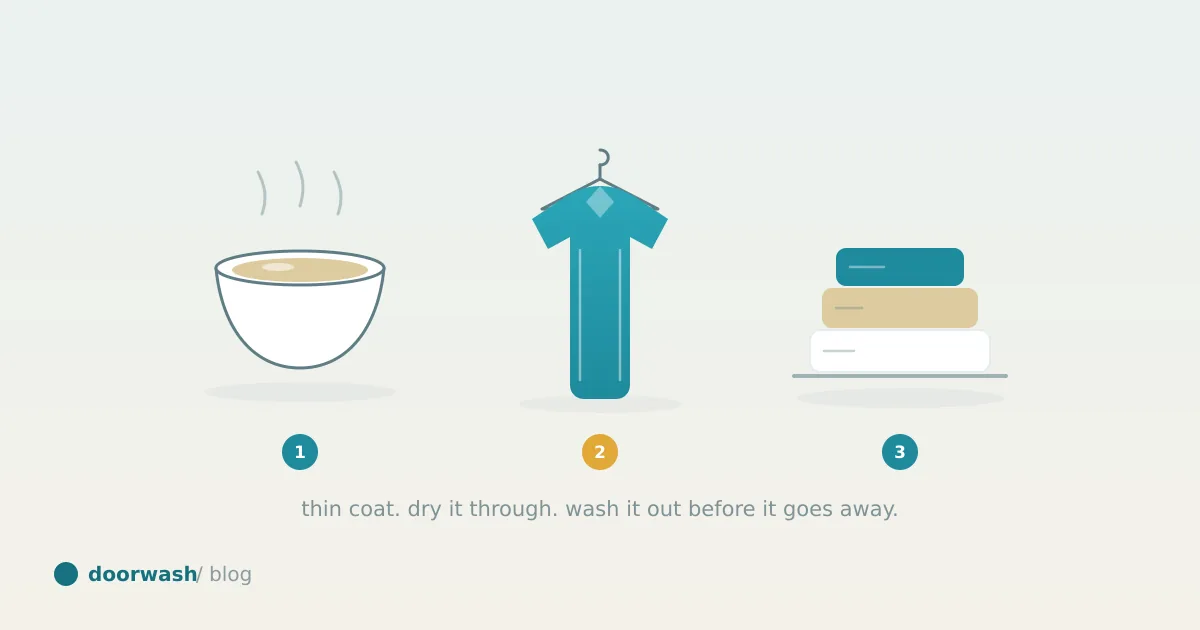
Keep it thin. One small katori of maand into a full bucket of water is enough for three or four kurtas. Starch is a film, not a soak. If the dry cloth feels like cardboard, you used four times what you needed, and all of that extra is going to sit there.
Never store anything starched. Before cotton goes into the almirah for a season, wash it plain and skip the starch entirely. This matters most for the clothes you wear twice a year. Those are the ones that get starched hardest and then left alone longest.
Dry it fast and dry it right through. A starched garment that stays damp on the line overnight is where the mould starts. Move air across it. Do not fold until it is bone dry at the seams and the waistband.
Leave synthetics and dark colours alone. Polyester will not absorb starch, so it flakes off in the creases. On a dark cotton, dried starch shows up as pale white lines exactly along the folds, and it looks worse than a wrinkle.
Strip the old coat before you add a new one. Soak the garment in water as hot as the fabric will take, move it around gently, and rinse twice. The water goes cloudy. That cloud is last month's starch. Do this every few washes and your whites will come back on their own.
And you are allowed to say no. Tell the shop halka kalaf, or none at all, for anything you are putting away.
The part that costs you nothing
Most of this is a timing problem. Cotton needs to be washed clean, dried hard and fast, starched thin only when it is going to be worn soon, and stored bare. In a Patna August, doing all four on your own terrace is a fight against the weather.
That is the work we do at DoorWash. Your clothes come back dry to the core, starched only where it makes sense, and free of the buildup you have been adding for years. You get your Sunday morning back, and the saree in your trunk survives to next Kartik.