Puja week. You take the tika at a pandal off Dak Bungalow crossing, walk into that October crowd, sweat under the collar, and wipe your neck with the back of your hand. At home you find it. A red-orange smear on the inside of your kurta collar.
You drop it in the bucket. You rub the spot with the soap bar. The mark opens up into a wide pink cloud twice the size.
It is now worse than when you found it.
What is actually in that packet
Sindoor is not a dye. A dye dissolves and bonds to the fibre. Sindoor is a very fine coloured powder suspended in an oily or waxy base.
Two parts, two separate problems.
The powder is a pigment. It does not dissolve in anything you have at home. It sits as solid particles, and cotton is a weave of tiny gaps, so those particles wedge down into the gaps and stay there.
The oil is what makes sindoor cling to skin all day in the heat. On cloth it does the same thing. It coats the fibre and it repels the water in your bucket.
So when you pour water on it, the water rolls off the oil and carries loose pigment sideways. When you rub it with a soap bar, you grind the pigment deeper into the weave and spread the oil out into a bigger circle. Every instinct you have is wrong here.
Why the order matters more than the product
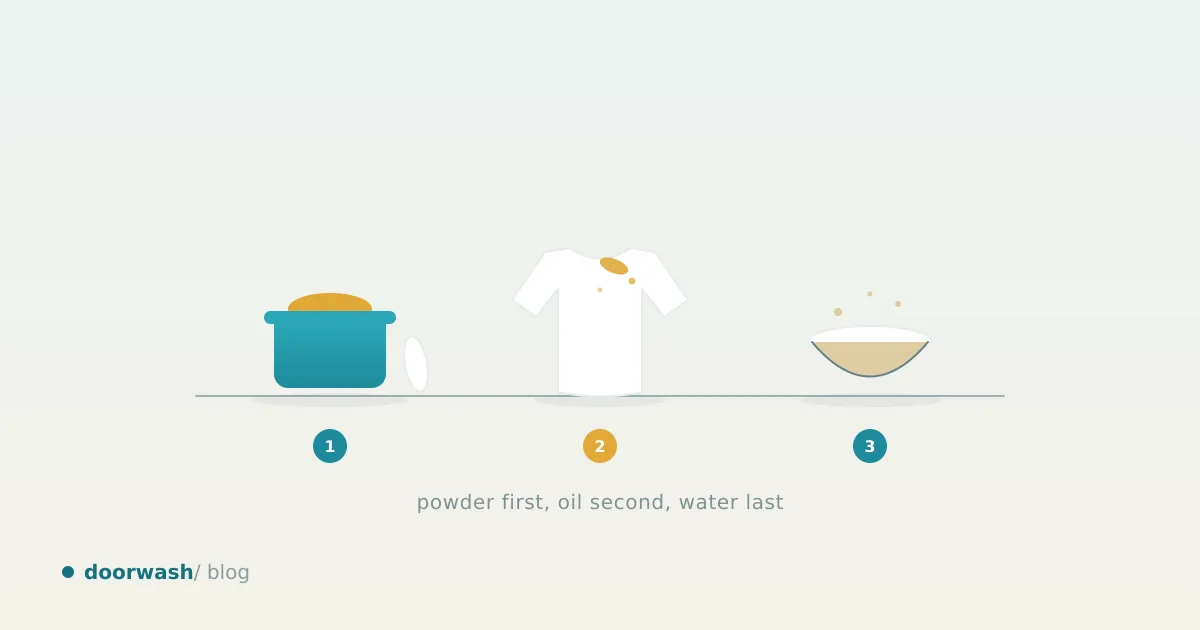
There is a sequence. Powder first, oil second, colour last. Do it out of order and you have set the stain permanently.
Do not put it in water. Not yet. Take the kurta off and lay it flat on a table, stain facing up. Water is the last step, not the first.
Get the loose powder out dry. Most of the sindoor is sitting on top of the cloth, not in it. Hold the fabric taut and tap the back of the stain hard with your finger so the powder falls out downward. If it is caked, scrape it with the back of a spoon, always toward the centre of the mark. Never brush across it. Brushing is how a one-rupee-coin stain becomes a palm-sized one.
Now pull the oil out. Cover the whole mark in dry talcum powder or cornflour. Leave it fifteen minutes. Powder draws oil up out of the fibre the way it draws it off your face. Brush it off gently and repeat once if the patch still looks dark and greasy.
Then break what is left. Put a drop of dishwashing liquid, the Vim type, straight onto the dry stain. That stuff is built for one job, cutting oil off a surface. Work it in with a fingertip for a minute. Give it five minutes to sit.
Rinse backwards. Hold the cloth over the tap with the stain facing down and run cold water through from the reverse side. You want the pigment pushed back out the way it came in, not driven through the cloth. Cold, always. Hot water sets an oily stain in seconds.
Repeat the dish liquid and the reverse rinse until the water runs clear. Then wash the kurta normally, cold.
The mistake nobody undoes
Check the spot while the cloth is still wet, before it goes anywhere near heat.
If a faint pink shadow is left, do not hang it on the terrace. Patna sun in October is still strong enough to bake pigment into cotton, and once heat has set it, that shadow is yours forever. Same with the iron. Same with a hot dryer.
For that leftover pink on white cotton, soak it in oxygen bleach, the sodium percarbonate powder sold as a whitener, in warm water for forty minutes. Skip the chlorine bleach. Chlorine does nothing to a mineral pigment, and with the iron in our water it tends to leave a yellow bloom that is harder to explain than the pink was.
If it landed on silk
Stop reading and stop touching it.
A Banarasi or a good silk saree will take a water ring from plain water alone, and the tap-and-scrape method will fray the surface fibres. Blot once with dry tissue to lift the wet oil, keep the rest of the powder dry, fold the saree with the stain on the outside so nothing transfers, and get it to somebody who cleans in solvent. The same goes for a wool shawl in December.
One more thing about the season
Gulal and abir are a different animal. That is talc with a water-soluble dye through it, so it comes out far more easily, but only if you do not wet it first. The dry-shake step is the same, and it matters even more.
And wash your hands after handling loose sindoor from an open packet. A lot of what is sold cheaply in the market is not the traditional stuff, and lead has turned up in tested samples often enough to take seriously. It does not belong on a child's clothes or in one's mouth.
Puja is four days. Your clothes should last longer than that.
If the thought of standing over a bucket in the middle of Navratri sounds like a bad trade, hand the pile to DoorWash. We pick up from your door in Patna and bring it back folded. Tell us which mark is sindoor and we will treat it before it goes near water.