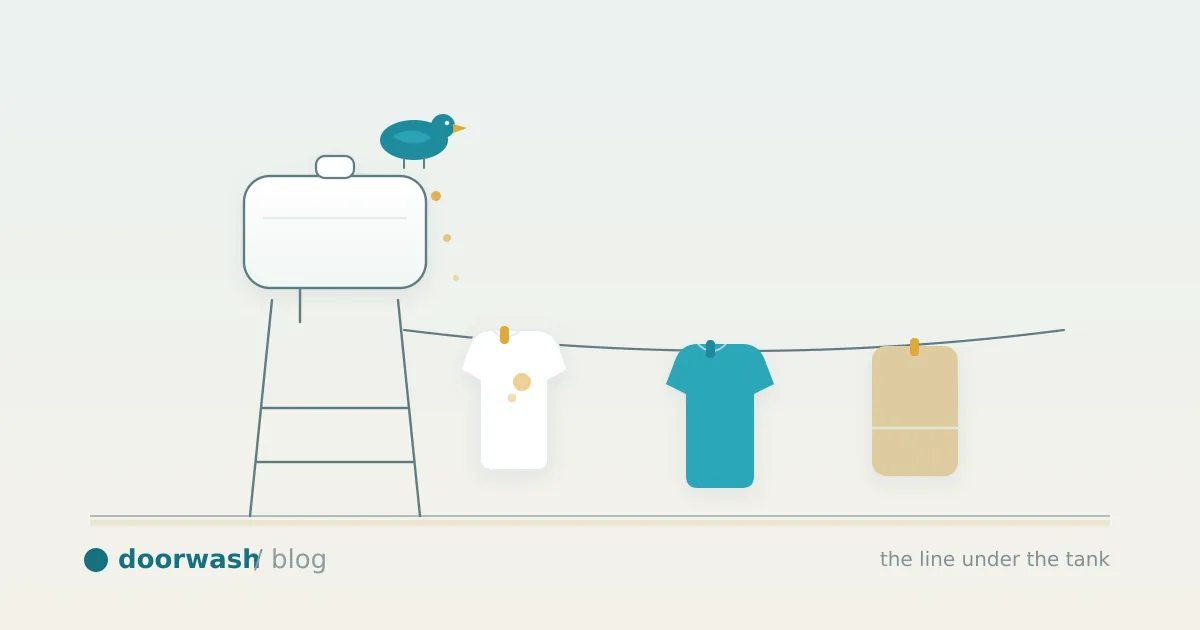
You go up to the terrace at seven. The clothes are dry. Down the back of your blue kurta, the one you were going to wear today, there is a chalky white and grey splash.
You know exactly where it came from. It came from the pigeon sitting on the water tank.
Most people do the same three things next. Rub it with a wet hand. Attack it with soap. Hang it back in the sun. All three make it worse.
What is actually in it
A bird does not separate its urine from the rest. The white part of that splash is uric acid. The dark part is food: seed husk, grit off the road, whatever it picked up near the sabzi mandi. Protein runs through all of it.
The mix is acidic. Leave it on dyed cotton in Patna heat for four hours and the acid does what acid does. It lifts the colour out. So you scrape the solid off and find a pale patch where the blue used to be. The stain leaves. The damage stays.
The protein behaves like blood or egg. Warm water cooks it into the fibre. Sun does the same thing, slower. Every hour that kurta hangs on the line with the mark on it, the mark gets harder to move.
That is why an afternoon dropping is a small job and a morning dropping you noticed at six in the evening is usually a lost kurta.
The first ten minutes
Take it off the line. People skip this and it is the whole first step.
Do not rub it wet. A fresh dropping is a paste with grit in it. Rubbing drives the grit and the pigment sideways into the weave, and a two-inch splash becomes a six-inch shadow you can never explain.
Let the solid go hard. If it is already dry, good. Lift it with the blunt edge of a spoon held flat against the cloth, sliding, not digging. Most of it comes off as a flake.
Now turn the kurta inside out. Hold the back of the stain under a cold tap so the water pushes the rest out the way it came in. Cold water only. From the wrong side only.
Then a little detergent with enzymes in it, worked in with your fingers, and twenty minutes to sit. Not an hour. Not overnight in a bucket. Wash it normally after that.
Check it while it is still wet, in daylight at the window. Wet cloth hides nothing. If a shadow is left, do it once more. If you dry it first and the shadow is still there, you have set it, and no second wash is getting it back.
Dry that one piece in the shade. The sun is not your friend until the mark is completely gone.
The pale patch that never comes back
Sometimes you do everything right and there is still a light halo on a dark kurta.
That is not a stain. The dye is gone from those threads. No detergent brings colour back, and bleach makes the ring wider and more obvious. You have two honest choices: wear it and stop looking at it, or take it to a dyer near Khajanchi Road and get the whole piece done in a darker shade. Anything else is throwing money at chemistry that has already finished.
The dust you are not thinking about
Look at your parapet. Look at the ledge behind the tank, and the top of the outdoor AC unit.
Old droppings sit there for months and turn to powder. On a dry windy afternoon that powder lifts and lands on whatever is hanging, and your clothes are wet, so it sticks. This is the grey film on a white shirt that had nothing spilled on it.
Dried pigeon droppings also carry fungal spores. It is a real thing, not a scare, and it matters if there is someone at home on steroids, on chemo, or with a weak chest. So do not dry-sweep a pile of it and stand in the cloud. Wet it down with water first, wear a mask, use a cloth you are willing to throw away, and wash your hands after.
Move the line two feet
Watch your terrace for one morning and you will see the geometry.
The birds sit on the highest thing: the tank, the dish antenna bracket, the cable running across, the stand's crossbar. They go over the edge from there. And your line, because it was easiest to tie there, runs directly underneath.
Move it. Two feet out from the wall, away from the tank stand, into the open middle of the roof where nothing is perched above it. That one change does more for your clothes than any stain remover.
If they have moved into the AC ledge or the exhaust pipe, get a proper net fitted, pulled tight, not the loose sagging kind that birds get tangled in and die in. If there is already a nest with eggs, wait the three weeks. It is not long, and poison and glue traps have no place on a roof where your clothes and your children go.
Right now it is worse
August in Patna is the wrong month for all of this. A dropping in dry May weather hardens in twenty minutes and flakes off clean. In this damp it stays soft for hours, seeps through the weave, and comes out the other side of the cloth.
So this is the season to hang the good clothes inside on a rack and give the terrace only your towels and bedsheets.
Or hand the whole load to us, and let somebody else look up at the tank.