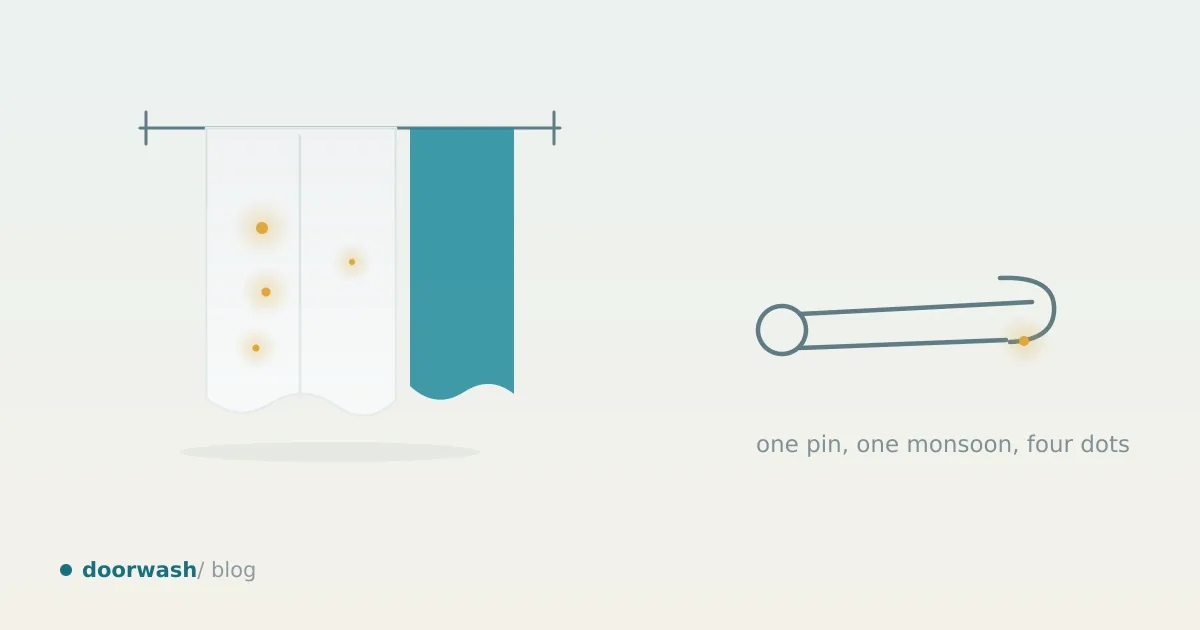
You take the saree out for the first function of the season. On the fold it looks fine. Then you open it under the tubelight and you see them. Four or five orange-brown dots, small, in a neat line down one edge. Exactly where the pins were.
That is rust. It came out of the pin and went into your cloth while the saree sat in the almirah doing nothing.
Steel does not need rain to rust
It needs damp air. Above about 60 percent humidity, a bare steel surface starts corroding on its own. In Patna, between the middle of June and the end of September, the air does not drop below that. Not at night, not with the fan on, not inside a closed steel almirah. Your trunk in Kadamkuan is sitting in the same wet air as your terrace.
Add one more thing and it gets faster. Sweat. Salt breaks down the thin protective layer on the pin and pits the metal underneath. So the pin that held your pallu on a July evening, the one you pushed through cloth that was slightly damp at the shoulder, is already halfway gone before you fold the saree away.
The pin corrodes. The corrosion is wet. It wicks into the fibre it is touching. Six weeks later you have a dot.
It is almost never only the pin
Look at where the marks are and you can name the metal.
A line of dots down the pleats is safety pins. A single dot at the shoulder is the pin at the pallu. Small marks along the back seam of a blouse are the hooks. A long faint orange streak across the shoulders of a hanging kurta is the almirah rod, the paint gone, the steel underneath breathing all monsoon. Two spots near the hem of a folded bedsheet, always in the same place, are the trunk latch. And there is the paper clip somebody left in a shirt pocket, which shows up as one hard brown dot with a shadow around it.
None of this is dirt.
Why your detergent does nothing
Detergent lifts oil and loosens soil so water can carry it away. Rust is not soil. It is iron oxide, formed inside the fibre, chemically stuck to it. Surfactants have nothing to grab.
So you rub. You use the brush. You give it a second wash with an extra scoop. The dot does not move, and now the fibre around it is thinner than it was.
There is a second problem nobody warns you about. Iron sitting in cotton acts as a catalyst. It keeps oxidising the cellulose around it, slowly, for years. Leave a rust dot in a cotton saree and one day you will put your finger through a hole in exactly that spot. The dot ate the thread.
Bleach makes it permanent
This is the one that costs people their good clothes. The dot is on white cotton, so out comes the whitening powder or the bleach bottle.
Chlorine and iron do the opposite of what you want. The chlorine oxidises the iron further and sets a yellow-brown mark that no acid will pull out afterwards. It also turns light spots dark. You had a fixable stain, and after that you have a ruined saree.
Same story with the sun. Everyone in Patna trusts the terrace to fix everything. On rust it does the reverse. Heat and light drive the iron deeper and darken it. Dry your clothes in the sun. Do not sun a rust mark before you have treated it.
What actually lifts it
Rust comes out with acid, because acid makes iron soluble again. Nothing else works.
On white cotton. Wet the spot. Cover it with lemon juice and a thick pinch of salt. Leave it fifteen minutes, keep it wet the whole time, then rinse in plenty of water and wash normally. Repeat once if the dot has faded but not gone. This is the only case where a short spell in the sun while the spot is still soaked in lemon helps, and only on white.
On anything coloured. Same lemon and salt, but work from the wrong side, test on the inside hem first, keep it under fifteen minutes, and keep it out of the sun. Acid and sunlight together will take the colour before they take the rust.
On silk, chiffon, zari or a Bhagalpuri. Stop. Do not treat it at home. Silk protein and metal zari both dislike acid, and zari threads have real metal in them that you can strip in one go. This needs a controlled treatment and a pH-neutral rinse afterwards.
And never use toilet cleaner. Half of Patna knows that Harpic takes rust off a floor. It is strong hydrochloric acid. It will take the dot out of your cotton and take the threads with it, sometimes not on the same day, which is why people think it worked.
Kill the pin, keep the saree
The cure is tedious. Not getting the dots is easy.
Use brass pins. Brass does not rust. The shiny steel pins from the crossing cost a rupee for ten and every one of them is a dot waiting to happen. Nickel-plated is no better once the plating gets a scratch, which is the first time you push it through cloth.
Take every pin out before you fold anything away. This is the whole trick. A pin does nothing to a saree you wear next week. It does everything to one you store till Durga Puja.
Wash the garment before storing it, and dry it all the way through, seams and folds included. Stored sweat is what starts the corrosion.
Wrap the almirah rod in a strip of old cotton, or hang your good clothes on wooden hangers away from it. Check your trunk latch. If it has orange on it, your clothes will have orange on them.
We handle a lot of these in the weeks before Durga Puja, when the whole city opens its trunks at once and finds out what August did. Bring it to us early, before somebody tries bleach on it. Rust caught in a week is a stain. Rust caught in a year is a hole.