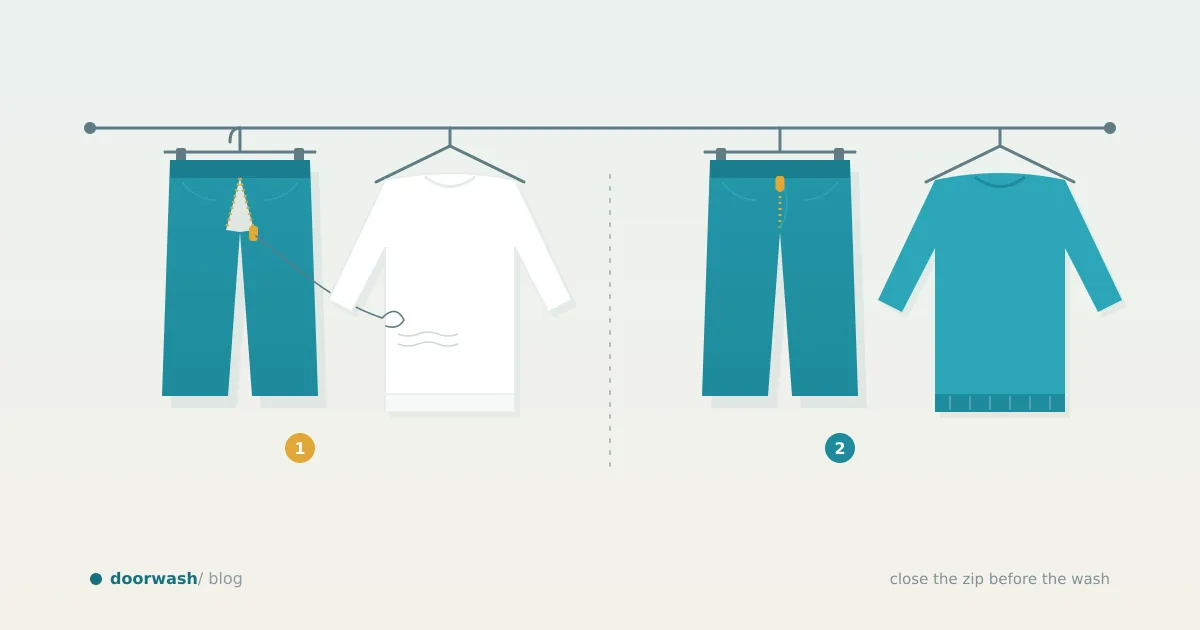
Look at your favourite cotton kurta. Hold it up to the window.
Somewhere near the hem, or along a sleeve, there is a pulled thread. A small loop sticking out. Maybe a line of tiny ladders where the weave has bunched up. You didn't catch it on a nail. You didn't wear it rough.
It happened in the wash. And the thing that did it was a pair of jeans.
A zip is a saw
Pick up any pair of jeans and look at the zip. Two rows of metal teeth. Each tooth has an edge. When the zip is closed, those edges lock into each other and face inward. When the zip is open, every single one faces out.
Now put that open zip in a drum with your kurtas, your T-shirts, your daughter's school shirt. The machine turns. Clothes tumble over each other for forty minutes. The open teeth drag across everything they touch, again and again, like a small saw.
Thin cotton gets pulled threads. Knits get snags. Anything soft gets roughed up a little more each Sunday, and you blame the detergent, or the machine, or the cloth itself.
It was the zip.
The same thing happens in a bucket. You soak, you rub, you wring the whole bundle together. The jeans are heavy and they win every fight.
Every metal thing in the load is a problem
Jeans are the obvious one. They are not the only one.
Blouse hooks. The little metal hooks on a saree blouse are made to grab. That is their job. In water, they grab whatever is near them. Chiffon, georgette, the fine border of another saree. One hook can pull a run through a dupatta you paid good money for at Hathwa Market.
Bra hooks. Same story. Open hooks catch on lace, on mesh, on the knit of a vest. They also bend, so after a few washes they stop closing properly.
Velcro. The strap on your son's school jacket. The flap on a rain jacket. Velcro in the wash is a patch of tiny plastic claws. It picks up lint, threads and fuzz from everything around it, and leaves the other clothes pilled and rough.
Hooks on trousers, belt buckles left in loops, keychain rings in pockets. You know the sound. That clanking in the machine. Every clank is metal hitting something.
Why this matters more right now
It is late October in Patna. The mornings near Gandhi Maidan have started to feel thin and cool. In a few weeks the trunks will open and the sweaters will come out.
Wool and knitted acrylic are the softest targets there are. A sweater is one long thread looped through itself thousands of times. Catch one loop with a zip tooth and pull, and the whole row puckers. You can't sew that back the way it was.
So the habit you build in the next two weeks decides how your winter clothes look in January. Your mother's cardigan. The school sweater that has to last two more years. The good shawl from Bhagalpur.
Right before Diwali, there are also the new clothes. The kurta for Lakshmi Puja, the saree for Chhath. New, delicate, and about to go into the same wash as your office trousers.
The fix takes thirty seconds
This is the whole method.
Close every zip before it goes in. Jeans, trousers, skirts, hoodies, jackets, pencil pouches if you wash those too. Pull it all the way up.
Hook every hook. Fasten blouse hooks into their eyes. Fasten bra hooks. If a blouse has too many to do quickly, turn it inside out so the hooks face in.
Stick the velcro down. Press both sides together firmly before washing. If a strap has nothing to stick to, fold it over itself.
Turn jeans inside out. It keeps the zip and the metal rivets inside. Bonus: your dark denim fades slower.
Empty the pockets. Keys, coins, the small screwdriver your husband keeps in his trouser pocket for no reason. Metal in a pocket hits the drum and everything near it.
Wash the rough with the rough. Jeans, canvas, school trousers and towels in one load. Kurtas, T-shirts, sweaters and anything with embroidery in another. It is one more load. It saves you a new kurta.
For the most delicate things, a cheap mesh laundry bag from any shop in Patna Market or a general store in your colony does a lot of work. Blouses, bras, anything with beadwork. It costs less than a plate of chaat.
Make it a doorway habit
The hard part is remembering. On a Sunday in a Boring Road flat or a PG room in Musallahpur, you are tired. You grab the whole pile off the chair and push it in.
So move the moment. Close the zip when you take the jeans off, not when you wash them. Hook the blouse when you change out of it. Do it at the door of the bathroom, where the clothes come off. Two seconds per piece. After a week you won't think about it.
Then tell everyone else in the house. One open zip from your brother's jeans does the same damage as yours.
What we do with your clothes
When DoorWash picks up a bag from your door, someone goes through it before anything gets wet. Zips get closed. Hooks get fastened. Velcro gets stuck down. Pockets get emptied, and whatever we find comes back to you in a small packet. Jeans go with jeans. Delicates go in mesh. Sweaters go in their own load.
Nobody thinks about this part. It is also the part that decides whether your clothes come back looking like they went in.
Close the zip. Your kurta will thank you, quietly, for years.