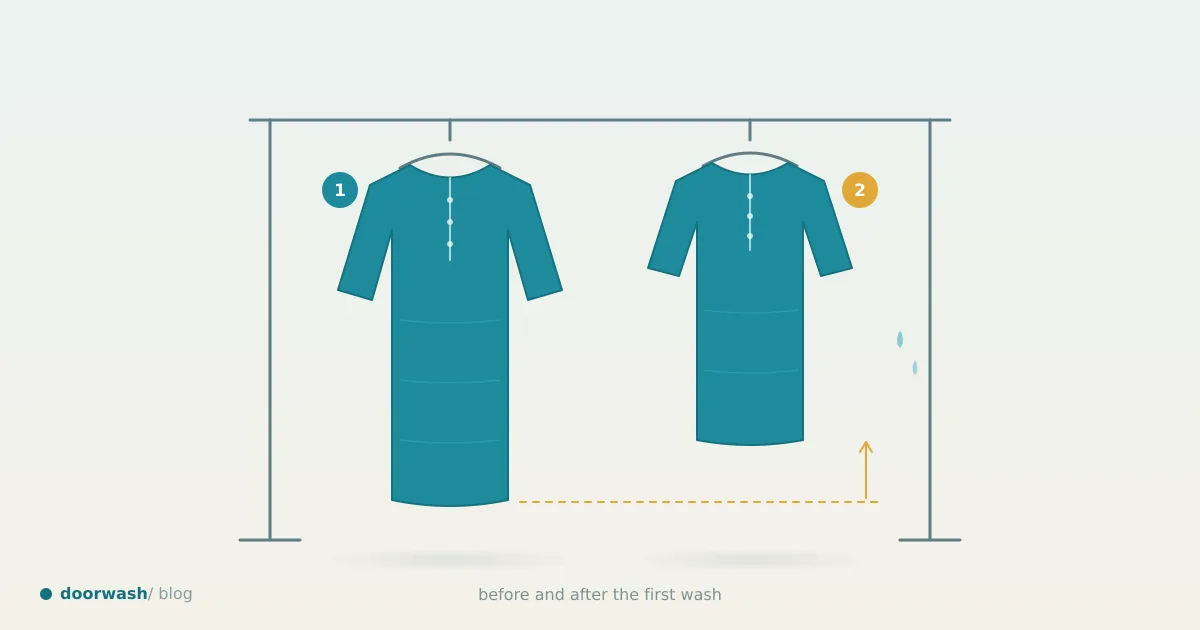
Every year around Gandhi Jayanti, the khadi rebate starts and Patna goes shopping. The Khadi Mall near Gandhi Maidan fills up. People leave with bags of kurtas, a couple of jackets, maybe a few metres of cloth for the tailor in Boring Road.
You probably bought something too. It fits perfectly in the trial room.
Wash it once the wrong way and that changes.
Why khadi shrinks
Khadi is cloth woven by hand from yarn spun by hand. That is the whole point of it. It is also the reason it behaves differently from the shirt you bought at a mall.
Factory cotton is usually pre-shrunk. The mill washes it, heats it and stretches it flat before it ever becomes a shirt. Most of the shrinking happens there, so you never see it.
Khadi skips that step. The yarn was twisted by a person at a charkha. The threads have loose spaces between them. The weave is open, which is why it breathes so well in a Patna afternoon. The first time that cloth gets properly wet, the fibres swell and pull together. The weave tightens.
A kurta can lose a few centimetres of length in one wash. Sleeves pull up. The chest gets snug. Hot water makes it worse. A machine on a hot cycle makes it much worse.
Nothing is wrong with the kurta. The cotton is finishing a job the factory skipped.
Before the first wash
If you bought cloth by the metre, do not hand it to the tailor dry.
Soak it first. Fill a bucket with plain cold water, put the cloth in, and leave it for two or three hours. No detergent. Then lift it out, let it drip, and dry it in the shade. Now it has done most of its shrinking. Now take it to the tailor.
Most tailors in Patna know this. Some will ask you, "kapda bhigoya hai?" If yours does not ask, tell them you already did.
If you bought a ready kurta, check the length against your knee in the mirror before you wash it. Some shops leave a little extra for exactly this reason. Some don't. If it already fits exactly, wash it gently and expect it to sit slightly higher afterwards.
How to wash it
Cold water. Every time. The water from your overhead tank in October is fine. Water heated in a bucket with a rod is not.
Wash it alone the first two or three times. Khadi, especially the deep indigo, rust and mustard shades, often uses dyes that bleed. One dark khadi kurta in a load can turn every white ganji in the bucket a faint shade of blue.
Use a mild detergent and a small amount of it. Swish the kurta in the water. Squeeze it gently. Do not scrub it on the bathroom floor and do not beat it with a thapi. Handspun yarn is uneven. The thin parts break first.
Do not wring it into a rope. Fold it, press the water out with your palms, and let it drip.
How to dry it
Inside out. In the shade.
October in Patna is beautiful drying weather. The monsoon is gone, the air is clear, the roof gets strong sun by eleven. That same sun fades a coloured khadi kurta in a few afternoons. Turn it inside out and hang it where the light is indirect: under the balcony shade, or on the side of the roof that faces away from the sun.
Hang it straight on the line, pulled flat by the shoulders. Khadi dries in whatever shape you leave it in.
How to iron it
Iron khadi while it still holds a little moisture. Bone-dry khadi wrinkles hard and the crease fights you. Slightly damp khadi lies down flat and stays there.
Use a medium-hot iron on the inside of the cloth. If you send it to the presswala at the corner, ask them to sprinkle water first and keep the iron moving. A heavy coal iron sitting in one spot leaves a shine on handspun cotton that never goes away.
It gets better
Here is the part people miss.
Khadi is stiff and slightly rough when it is new. After ten washes it is soft. After fifty it feels like the most comfortable thing you own. The colour settles into something gentler. The cloth starts to drape.
A factory shirt is at its best the day you buy it. Then it gets worse.
Khadi works the other way. It needs a careful first month, and then it rewards you for years.
So treat the first wash like it matters. Because it does. Cold water, no scrubbing, shade, a damp iron. Do that and the kurta you bought this October will still fit you next October, and it will feel better than it does today.