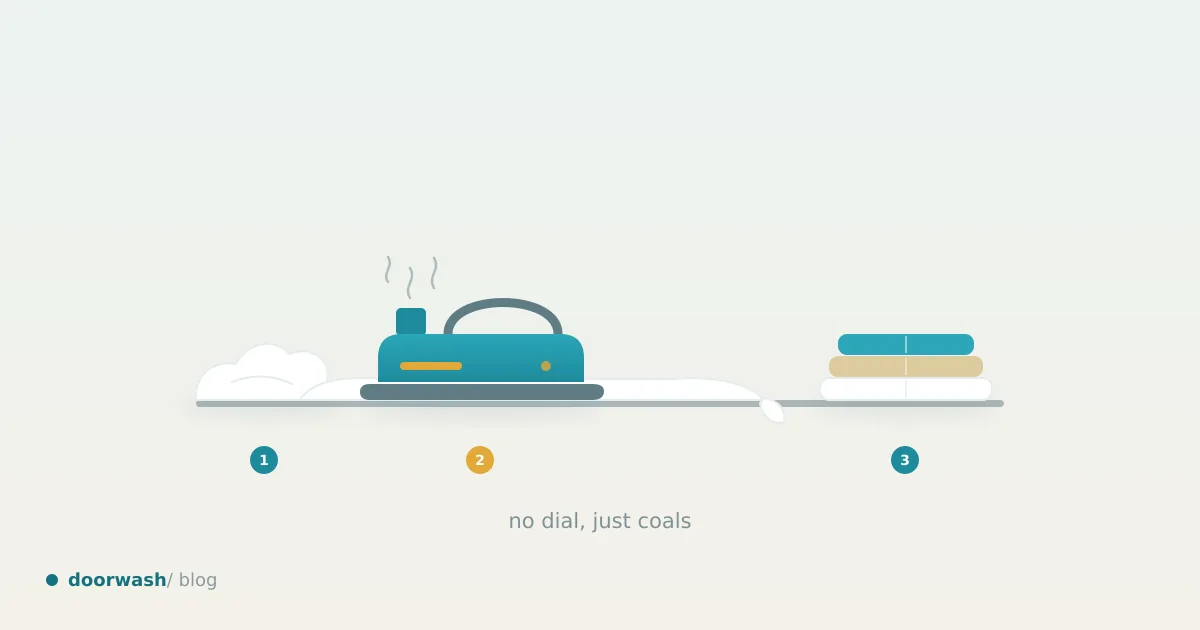
Walk down any lane in Kankarbagh at seven in the evening. There is a cart under a tin sheet. A wooden board wrapped in layers of old cloth. A man standing over it with an iron that weighs five kilos. He takes your shirt, presses it in ninety seconds, and charges you six rupees.
He is very good at his job. Twenty years of practice, and he can get a collar flatter than you ever will.
The trouble is not the man. It is the iron.
There is a fire inside it
Lift the lid on that iron and look. Coals. Burning.
It is a hollow metal box with vents cut into the side to keep the fire breathing. No dial. No thermostat. Nothing to set. When the coals are fresh the sole plate crosses 250 degrees. An hour later it is down near 130. He reads the heat off his own hand, or off the way a flick of water skids across the plate. He is usually right, because cotton forgives almost everything.
Your polyester shirt does not forgive anything.
What comes off that plate
Three things travel from the iron into your clothes, and none of them are visible on the cart.
Ash. Coal makes fine grey ash, the vents let some of it out, and it drifts down onto whatever is on the board. On a check lungi you will never see it. On a white shirt it shows up as tiny grey-black specks that look like they came from a pen. Wipe one with a dry finger and it smears instead of lifting. That is soot.
Everybody else's clothes. That plate touched two hundred garments today. Starch from a kurta, dye off a fresh red dupatta, hair oil off a pillow cover, wax off a printed t-shirt. It all bakes onto the metal in a thin brown film, and the next hot pass moves a little of it onto the next shirt. This is why the mark you find is often on the back or the cuff, in a spot where nothing could have spilled.
Water. There is a plastic bottle on the cart with a hole punched in the cap. It gets refilled from the nearest tap. Patna groundwater carries iron. Spray it on white cotton, press it hot, and the iron oxidises into the fibre. The shirt looks fine that evening. Three weeks later there are faint orange-brown dots along the shoulder and you blame the detergent.
What should never go on that board
Cotton is safe. A cotton shirt, a cotton kurta, a dhoti, a bedsheet, a pair of chinos. Send them. This is what the coal iron was built for and it does the job better than the appliance in your house.
Everything else needs a second thought.
Polyester and nylon melt at around 250. That is inside the coal iron's normal range. A dri-fit shirt or a formal shirt with a poly blend does not scorch and go brown. It goes shiny, then thin, then it opens into a hole shaped exactly like the nose of the iron. That damage is permanent. No wash fixes it.
Rubber prints on t-shirts turn sticky, lift, and crack. Sequins on a party kurti curl and pop off. Zari goes flat and dull in one pass. Buttons made of resin, the cheap pearly ones on shirts from Hathwa Market, deform and go milky. Zips warp so they stop closing at the third tooth.
And viscose. Half the light kurtas sold in Patna now are viscose or rayon, sold to you as "cotton feel." It scorches faster than cotton and holds the yellow mark forever.
The two minutes that save the shirt
If you are pressing at home, three habits matter more than the machine you own.
Turn the garment inside out. Whatever the plate does, it does to the wrong side.
Put a thin cotton cloth between the iron and anything printed, dark, or synthetic. An old handkerchief is enough.
And never iron a shirt that is not fully dry. In August people press damp clothes to finish the drying, especially when the sky has been grey for four days. What you are doing is trapping warm moisture inside cotton and sealing it into a folded stack. The mildew smell you get on Thursday started on Monday, on the ironing board.
One more. Let a pressed shirt hang for ten minutes before it goes into the almirah. Hot cotton is soft cotton. Stack it while it is still warm and you press the fold of the shirt below it into a permanent second crease, and you seal Patna humidity in with it.
Ask him for one thing
Next time you hand over the pile, say one line: keep the shiny ones out.
Any decent press-wallah already knows. He will run those on a cooler iron, or he will refuse them, and that refusal is him protecting you. The ones who take everything without looking are the ones who leave holes.
We took a different route. Our clothes go on a plate with a temperature dial, wiped between loads, fed clean water from a bottle we fill ourselves. A cotton shirt gets 180 degrees. A poly-blend shirt gets 110 and a pressing cloth. Nobody guesses.
Your shirt gets pressed, and it comes back the same shirt.