Pull a shirt out of your almirah and hold it up against the window light.
Look at the shoulders. Two small points, one on each side, pushing out past the seam. Little horns. Nobody sold you a shirt with horns.
Now check your favourite t-shirt at the neck. Wider than it used to be. The collar sits lower on your chest than it did last year.
Same cause. The hanger.
The wire one is packing material
The thin steel hanger your press-wala sends your clothes back on was never meant to be kept. It is packing. Its job is to get the shirt from his shop to your gate without a crease, and that job ends at your gate.
Then you slide it into the almirah and leave it there for three years.
Look at how thin that wire is. Two millimetres. Your shirt weighs around 200 grams and every one of those grams is sitting on two points the width of a matchstick. Cotton does not push back. The fibres at the shoulder seam spread around the wire and stay spread. That is the horn, and no amount of pressing takes it out for good.
A broad hanger carries the same shirt across four inches of shoulder. Same almirah, same weather, no horns.
The orange mark you blamed on the food
Here is the Patna part.
Steel rusts, and in June and July the humidity here sits above 80 percent for weeks. Your almirah is a shut wooden box full of that air. If the chrome on a wire hanger has one chip in it, that chip goes orange. Then it lies against white cotton for four months.
You take the shirt out for a wedding and there is a rust-brown line across the shoulder, or a dot near the collar. It looks like old chai. You rub soap into it and it spreads and darkens, because iron does not come out with detergent.
Run your finger along the inside of every wire hanger in the house. If it comes back orange, throw away the hanger, not the shirt.
Never hang a wet kurta
This is the one that costs the most and nobody connects it to the damage.
You wash a cotton kurta. To save space on the terrace line you put it on a hanger and hook the hanger over the line or the grill. Wet cotton holds a lot of water. That kurta now weighs close to three times what it does dry, and all of that weight is pulling straight down through two shoulder points.
Wet fibres stretch. Then they dry in the stretched shape and keep it.
That is why one kurta hangs longer on one side. That is why the shoulder seam has crept halfway down your arm. The wash did not do it. Twenty hours on a hanger did.
Wet clothes go over the rope, weight spread across the whole width of the cloth. Heavy knits go flat on a dry towel. Hangers are for dry clothes.
Knits do not go on hangers at all
A woven shirt has a fixed structure. A knit is one loop of yarn holding another loop, and it will go wherever gravity tells it. Hang a sweater for a season and you will pull out something with shoulders shaped like a coat hook.
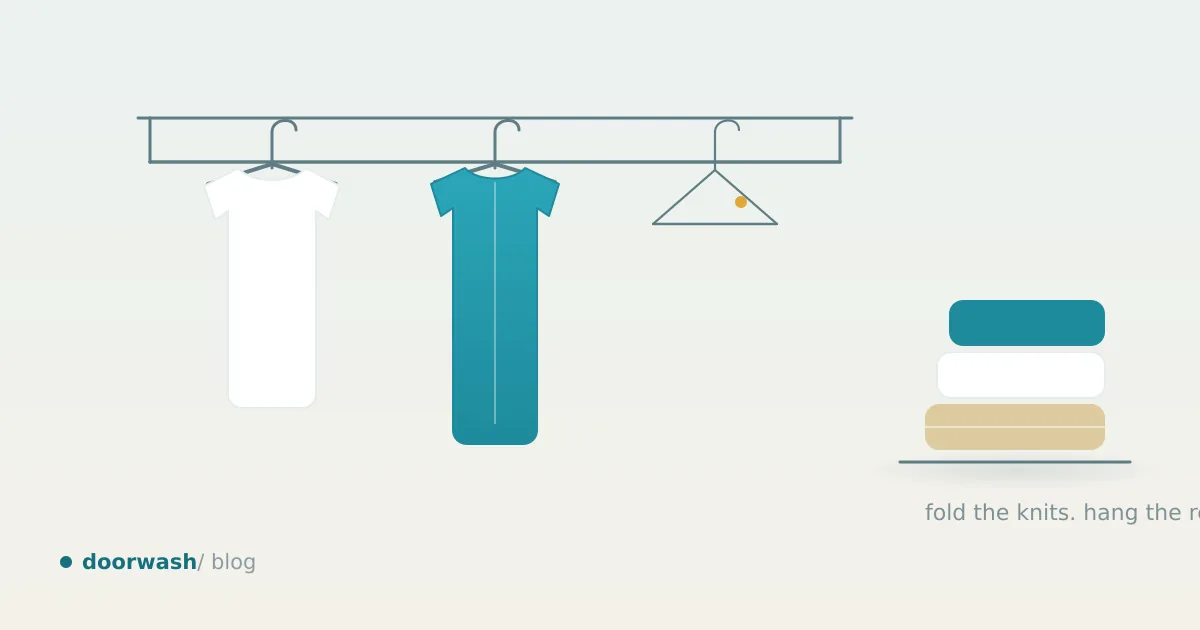
Fold your knits. Sweaters, t-shirts, sweatshirts, jersey kurtas. Flat, in a stack, on a shelf.
The rod is too full
Open the almirah and push the clothes apart with your hand. If they push back at you, the problem is bigger than shape.
August in Patna does not let cloth dry all the way through. Something on that rod is still holding water in a seam or a waistband. Packed tight, no air moves between them, and mildew starts in the dark where fabric touches fabric. You will smell it on a shirt before you ever see it.
Leave two fingers of gap between hangers. That is not tidiness. That is airflow.
What to buy
Go to the plastic goods lane in Maurya Lok, or any general store near you, and pick up ten broad plastic hangers with a curved shoulder. Sixty rupees, maybe eighty. Wooden ones for the blazer and the sherwani, because those need width and strength.
Then throw out every wire hanger in the house. All of them. More will arrive next week with the pressed clothes, and those go out too.
Your clothes spend eight hours a day on your body and the other sixteen hanging in a dark box. The thing holding them for two thirds of their life should not be a piece of bent wire.
We pick up, wash, press and deliver across Patna. Tell us to fold your knits instead of hanging them and we will.