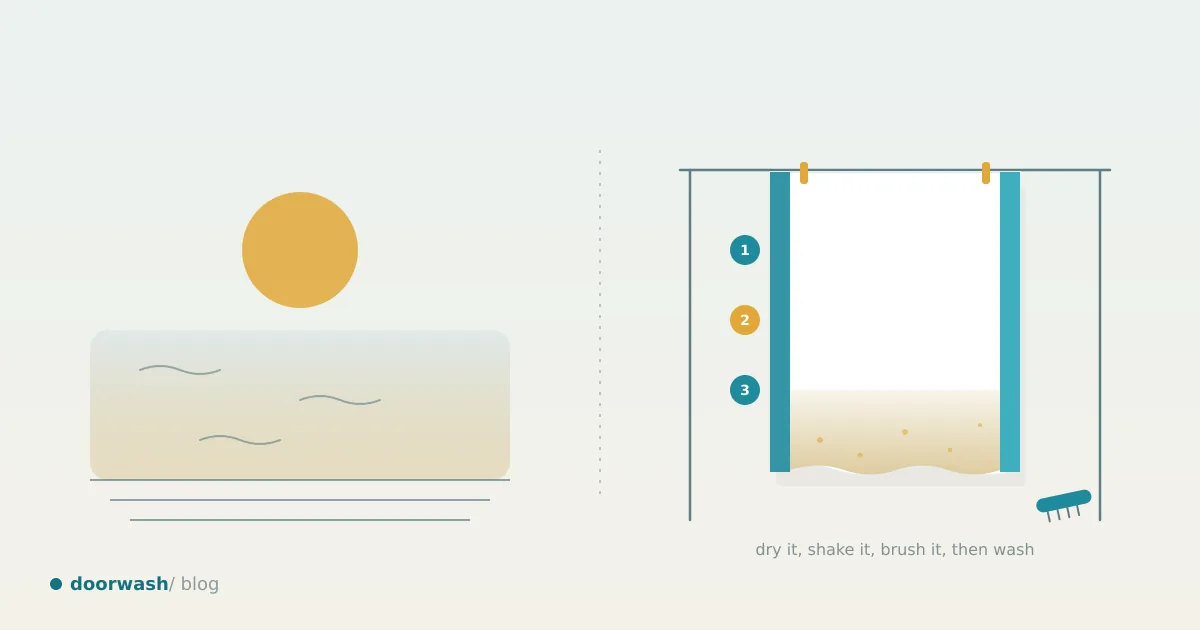
Stand on Collectorate Ghat at sunset on the evening of the first arghya. Look at the water line on every saree around you.
It is the same everywhere. A brown band, a hand or two deep, running along the bottom of the cloth. The vrati walks into the Ganga up to the waist, holds the soop up to the sun, and stands there. The river does what rivers do. It leaves something behind.
Most of us think of that brown band as water. It dries, it lightens, we forget about it. Then a month later the saree comes out of the trunk and the hem is a shade darker than the rest. Stiff. A little rough under the thumb.
That is the Ganga. It came home with you.
What the river actually carries
The river at Patna carries half of north India with it. By the time the Ganga reaches Gandhi Ghat it has picked up silt from Uttar Pradesh, from the Ghaghra, from fields and towns for hundreds of kilometres. In November the flow is slower than in the monsoon, so the finest particles hang in the water and settle on anything that sits still.
A saree standing in the river for half an hour is something sitting still.
These particles are tiny. Much finer than the dust on Bailey Road. Fine enough to slip between the threads of a cotton saree and lodge there. Plenty of that silt carries iron, which is why the stain often has a reddish edge once it dries.
Then the cloth goes into a polythene bag. It stays wet in the car, wet through the night, sometimes wet until the morning arghya is over and the family has eaten. By then the silt has had twelve hours to settle into the weave.
The mistake everyone makes
You get home. The hem is muddy. You put it under the tap and rub.
This is the worst thing you can do.
Wet silt behaves like paint. When you rub it, you push it deeper into the threads and spread it sideways. A two-inch band becomes a four-inch band, lighter but wider, and now it sits inside the fibre instead of on top of it. Scrubbing with a brush while it is wet does the same thing, only faster.
Hot water does not help either. It will not lift the clay, and on a dyed cotton or a tant saree it will pull colour out of the border while you are at it.
What works
The answer is patience, and it starts with doing less.
Let it dry first
Hang the saree, or at least the bottom half of it, and let the mud dry completely. Do not fold it. Do not bag it. Open it out over a chair or a line so air reaches both sides of the hem. In Patna in November this takes a few hours in the afternoon sun.
Dry silt is a powder. Powder comes off.
Shake and brush
Take the dry hem outside. Shake it hard. A lot of the brown will fall away on its own. Then take a soft, dry brush, a clean old toothbrush works for the pleats, and brush along the weave. You are lifting the dust out of the cloth.
You will be surprised how much of the stain leaves at this stage. Sometimes most of it.
Soak in cool water
Now the water. Cool, never hot. A bucket with a small amount of mild detergent, the kind you would use for a delicate kurta. Lay the hem in and leave it for twenty minutes. Silt that is still in the weave loosens when it is left alone.
Swish it. Lift it. Squeeze the water through the cloth with your hands. Do not twist.
Change the water if it turns brown and do it again.
The rust edge
If there is still a reddish line after all this, that is the iron. Regular detergent will not move it. A little lemon juice on that line, left for ten minutes in the shade and then rinsed, often takes it out on white or light cotton. Test it on an inside corner first. On a dark or printed saree, or anything with zari, leave the iron alone and give it to someone who cleans these for a living.
The dhoti, the kids, and the soop cloth
The saree gets the attention. Plenty else went into the river too.
The men's dhotis go in, often white, and white shows everything. The children who ran down the ghat steps came back with silt up to the knees of their new kurta pyjamas. The cloth you laid under the soop, or wrapped the thekua in, picked up whatever was on the steps.
All of it gets the same treatment. Dry, shake, brush, soak cool. White cotton forgives you more than coloured silk does, but it still does not forgive rubbing wet mud.
Why it matters
Most families keep one saree for Chhath. Often it was bought for this, worn for this, kept for this. Some families pass them down. Your mother's saree from twenty Chhaths ago has a brown hem because nobody knew the river needed to dry before it could be washed out.
Now you know.
Do it once, the right way, the day after the morning arghya. Or bring the whole bag to us, mud and all, and tell us it came from the ghat. We will know what to do with it.