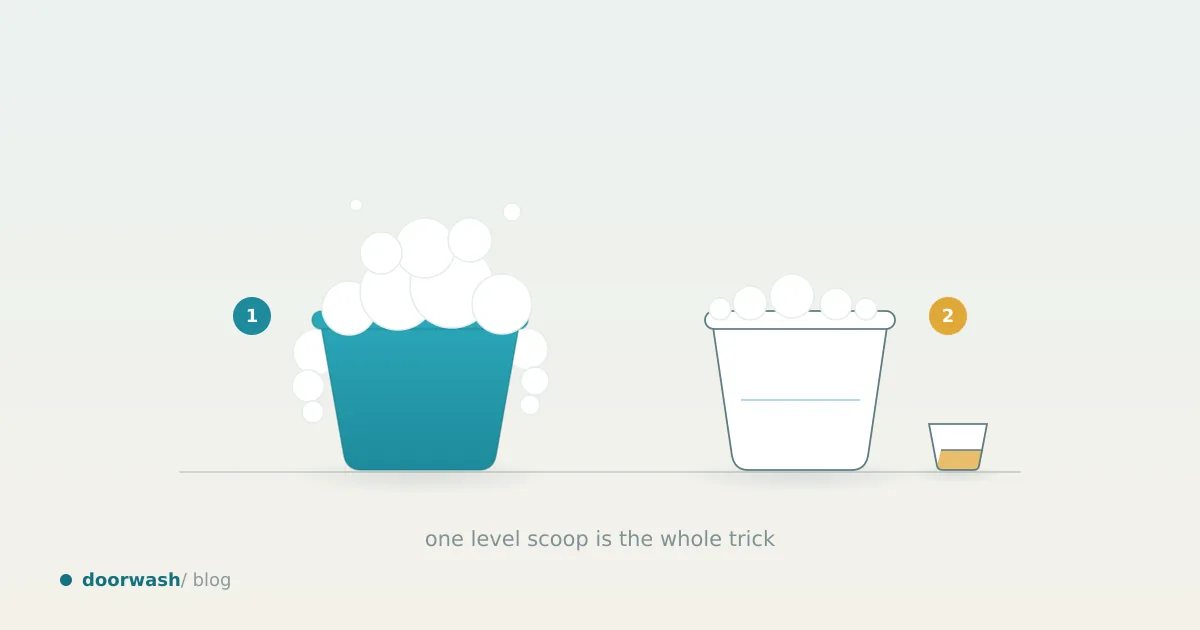
Go find your detergent packet. Turn it over. There is a small line on the back that tells you how much to use for one bucket. Twenty grams. Maybe twenty five.
Now think about what you actually put in. A steel mug, heaped, tapped down at the edge. That is close to a hundred grams.
Four times too much. Every single wash, for years.
Why we all do it
Patna water is hard. It comes up from the ground carrying calcium, magnesium and iron, and detergent has to deal with all of that before it can even look at your shirt. The first part of every scoop dies fighting the water. Nothing is left over to make foam.
So you look into the bucket, you see thin grey water and no bubbles, and you reach for the packet again.
That reflex is the whole problem. It got taught to you by the water in your tap and by thirty years of advertising that showed a mountain of white foam and called it clean.
Foam does not wash anything
Foam is a side effect. The molecules that lift oil off cotton do their work whether or not they make bubbles. Front-load machine detergent is deliberately built to make almost no foam at all, and it cleans better than anything you use in a bucket.
Bubbles are for the camera. Your clothes cannot see them.
The soap does not leave
Here is the part nobody tells you. Cotton is a sponge. It holds detergent the same way it holds water, deep in the fibre, not on the surface.
To get it out you need rinse water that is genuinely cleaner than what is in the cloth. In a bucket, you drain, you fill again, you squeeze, and you call it done after two rounds. The second rinse water still has soap in it. Whatever is left dries inside the fabric and turns hard.
That is the stiffness. That is the crunchy towel, the scratchy ganji, the shirt that feels like paper at the shoulders. It is not old cotton. It is a shell of dried detergent sitting on the threads.
Four things it quietly ruins
Your towels stop working. A towel dries you because water climbs into the fibre. Detergent residue is waxy and repels water. You rub harder, the towel just pushes the water around. Everybody blames the towel. It is a year of extra soap.
The smell comes back in a day. The residue is sticky. It grabs body oil, holds moisture, and keeps a damp patch alive in the middle of a folded towel. In a Patna August that is a sour smell by the next evening, on something you washed yesterday.
Your skin itches and you blame the heat. Behind the knees. Along the waistband. The back of the neck. That thin rash you get in July gets put down to prickly heat, and half the time it is soap you never rinsed out, pressed against wet skin for nine hours.
Your machine chokes. Powder that does not dissolve in cold hard water does not disappear. It settles with lint into a grey paste behind the drum and under the gasket, and that sludge grows things.
What to actually do
Measure it once. Use a kitchen scale, or fill your detergent cap to the line, level, one time, and then find something in your kitchen that holds the same amount. A small steel katori is usually close. Use that from then on and stop guessing.
Dissolve the powder before the clothes go in. This is the biggest one for Patna. Put the detergent in the empty bucket, pour in a mug of hot water, stir until the grains are gone, then fill up and put the clothes in. Cold hard water leaves half the powder sitting there as grit.
Add one more rinse than you think you need. Squeeze a corner of the cloth in the last rinse water. If it makes even a little slip or slime on your fingers, there is still soap in it.
Then strip what is already there. Take your worst towels, run them through with no detergent at all, in the hottest water the fabric allows. Add half a cup of white vinegar at the final rinse. Do it twice if the water goes cloudy. The towels will come back thicker and thirstier than they have been in two years, and you will not believe how much came out.
The cheaper habit is the better one
There is a nice thing hiding in all this. Doing it right uses less soap. A kilo packet that used to last three weeks lasts two months. You spend less, your clothes last longer, and they feel like cloth again.
That is rare. Usually the better way costs more.
If you would rather not think about scoops and rinse water at all, we do this for a living. DoorWash picks up from your door in Patna, weighs the load, doses to the load, rinses until the water runs clean, and brings it back folded. Either way, put the mug down.