Quarter to nine on Bailey Road. The light at Hartali Mor sits red for ninety seconds. You pull your dupatta up over your nose and hold it there with one hand, the other on the handlebar. A bus pulls out ahead of you. You keep the cloth on your face until you turn into the office lane.
That cloth was on the floor of an auto on Tuesday.
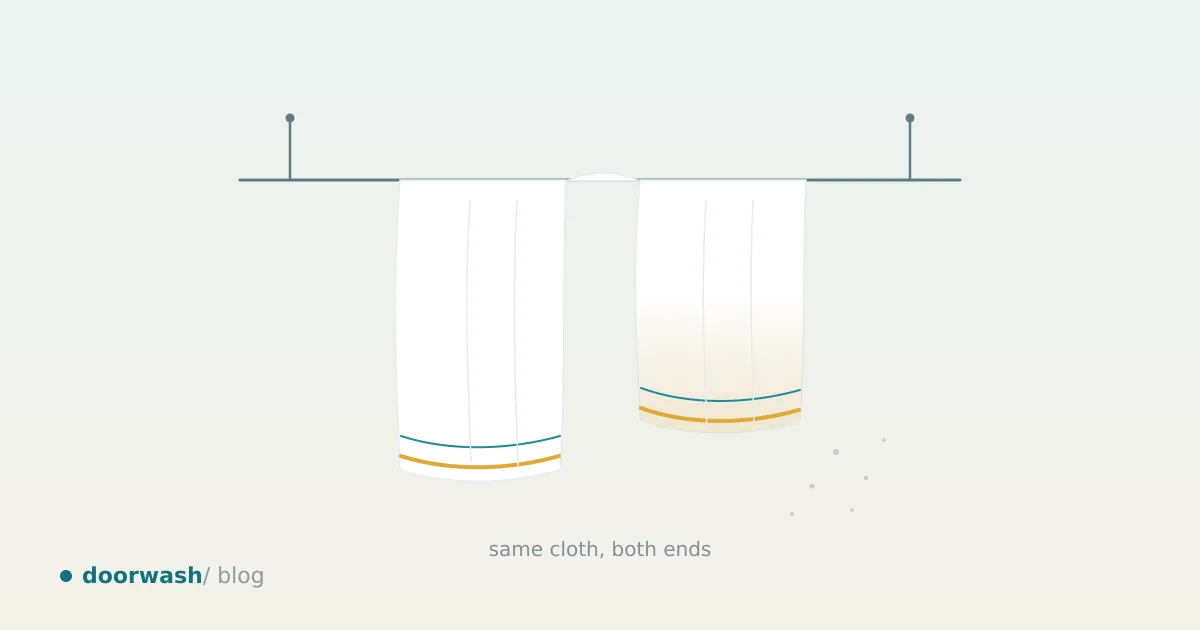
Same dupatta. The end that trails when you sit is the end that goes over your face when you ride. You have never thought about it, because a dupatta does not look dirty. That is the whole problem.
It never looks dirty, so it never gets washed
Count how you actually treat it. The kurta comes off and goes straight into the bucket. The dupatta goes back on the hook behind the door. Tomorrow it goes over a different kurta. By Friday it has done five days and it is still on that hook.
A cotton kurta tells you when it is finished. It creases. It goes limp under the arm. A chiffon or georgette dupatta does none of that. It is thin, it is printed, and it hangs on day nine exactly the way it hung on day one. Dirt settles into a loose weave and changes nothing you can see from arm's length.
Take it to your window in daylight. Hold up the middle section, the part that sits across your shoulder. Now hold up an end. The end is darker. That extra grey is the road.
What is actually sitting in it
Three things, in this order.
Dust. Not soft dust. Patna road dust is crushed stone off the construction stretches, brake lining from every bus on Bailey Road, and diesel soot. It is hard and it has edges. It works into the weave and stays there.
Moisture. Breathe through cloth for twenty minutes and you push warm, damp air into it twice a second. The section over your nose stays wet for the whole ride. Damp cloth grabs dust the way a wet rag picks up crumbs off a table.
Oil. Off your fingers after a samosa, off your face, out of your hair. Then you fold the dupatta and hang it in the dark until tomorrow.
Now the two ends meet. The end that swept the auto floor gets folded against the end you breathe through. Whatever was on one is on the other by morning.
How often it needs washing
If it went over your face on a ride, wash it that night. Every time.
If it sat on your shoulder in an office all day and nothing else, three wears.
If it touched food, or you wiped your hands on it, wash it. You know you do this.
None of this is a big job. A dupatta is two hundred grams of cloth. Four minutes in a bucket, dry in an hour.
Wash it on its own
Do not put it in the machine with the kurta. That habit destroys more dupattas in this city than road dust ever will.
Here is what happens inside the drum. A wet cotton kurta weighs over a kilo. The spin throws that kilo against two hundred grams of chiffon and drags it around. The lace at the border pulls. The weave goes out of square, and once the grain is pulled crooked, it hangs crooked forever. No amount of ironing puts it back.
So do it by hand. It takes less time than arguing with yourself about it.
Cold water. Warm water sets sweat into the fibre and lifts colour out of the print.
A capful of mild liquid detergent, not a scoop of surf.
Ten minutes soaking. No more.
Press it, do not rub it. Work the section that sits over your nose between your palms, because that is the dirty part and everyone washes it the least.
Never wring it. Never twist it. Lay it flat in a dry towel, roll the towel up, and press down. The towel takes the water out.
Dry it in shade. Fold it in half over a wide line so the weight spreads along the fold instead of hanging off two clips. Three hours of direct Patna sun on a printed dupatta will take the colour out of the top fold and leave a pale stripe running the length of it.
Iron on the lowest setting with a thin cotton cloth laid on top. A synthetic dupatta melts before it scorches, and the shine that leaves behind does not come out.
The hook behind the door
That hook is where dupattas go to be forgotten. Everything else you own has a rule. Kurtas go in the bucket. Jeans go in the pile. Bedsheets come off on Sunday. The dupatta has no rule, so it defaults to later, and later turns into the sixth day.
Give it a rule. It goes over your face, it goes in the wash.
We pick up across Kankarbagh, Rajendra Nagar, Boring Road, Patliputra and Kadamkuan. Delicates get separated out and washed by hand, dried flat, in shade. Your dupatta comes back the shape it left in.