Diwali night. You are lining the balcony railing with candles because the wind off the road keeps putting out the diyas. Your sleeve brushes one. A thick drop of red wax lands on the cuff of your new kurta and goes hard before you notice.
The next morning someone in the house says, put it in hot water, it will melt.
Don't.
What wax actually is
A candle is mostly paraffin. That is a petroleum wax. It melts somewhere around 50 to 60 degrees, which is why it softens in your hand and goes runny near a flame.
Hot water does melt it. Then it spreads. The liquid wax runs along the threads and soaks into the weave. A drop the size of a coin becomes a greasy patch the size of your palm. When the water cools, the wax goes solid again, now inside the cloth instead of sitting on top of it.
Detergent doesn't help much either. Wax is not dirt. It is a solid fat. Surf can't grip it until most of it is already gone.
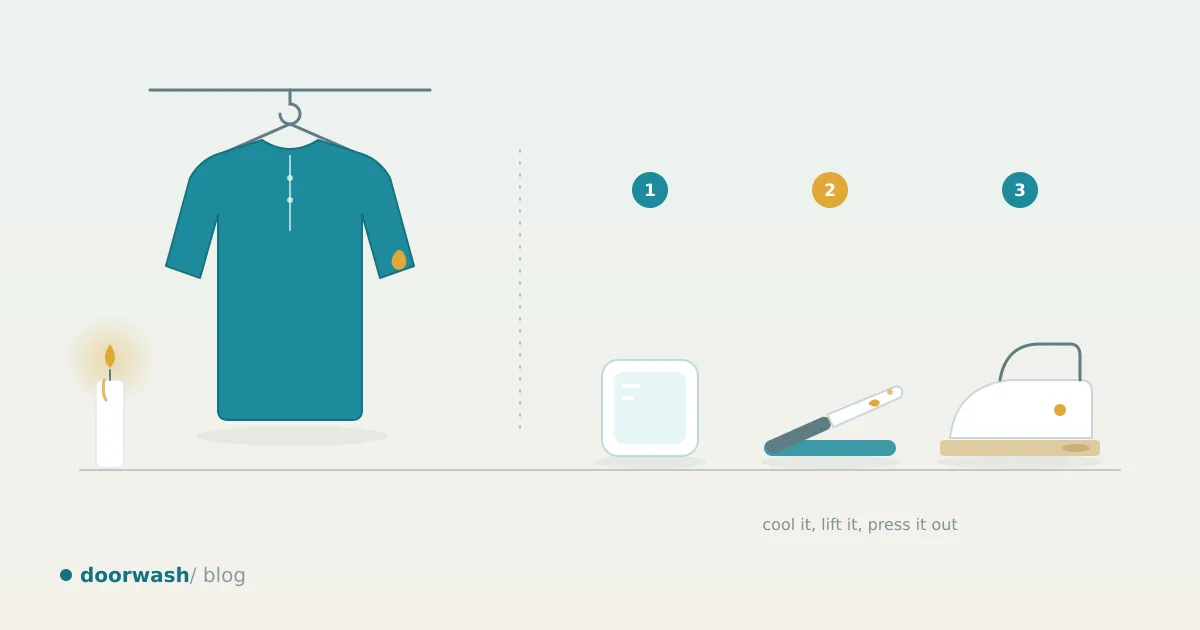
So you don't wash wax out. You lift it out, in three steps, and only then do you wash.
Step one: make it brittle
Leave the drop alone until it is fully hard. If you can't wait, hold an ice cube against it in a plastic bag for two minutes. Or fold the kurta and put it in the freezer for twenty minutes, next to the peas.
Cold wax is brittle. Warm wax smears.
Step two: scrape, gently
Take a butter knife or the edge of an old debit card. Not a sharp knife. Bend the cloth over your finger so the wax lifts off the surface, and flake it away a bit at a time.
Most of the drop will come off this way. What stays is a thin layer pressed into the weave, usually darker and shinier than the cloth around it.
Do not rub it with your thumbnail. Rubbing heats it and pushes it in.
Step three: iron it into paper
This is the part that surprises people.
Get a brown paper bag. The kind your kirana shop in Kankarbagh or Rajendra Nagar packs atta in is perfect. Plain paper towels work too. Cut two pieces.
Put one under the stain and one on top. Set the iron to low, the silk or synthetic setting, and press for a few seconds. No steam.
Lift the paper. You will see a wet, dark spot on it. That is your wax. The heat melted it and the paper drank it up.
Move to a clean part of the paper and press again. Keep going until the paper comes up clean. On cotton this takes three or four passes.
Never use newspaper. The ink comes off on a warm iron, and now you have a wax problem and a print problem.
The shadow it leaves behind
Sometimes the wax is gone and a faint mark stays. There are two kinds.
A see-through, oily patch. That is the oil left over from the wax. Put a drop of dishwashing liquid on it, rub it in with your finger, leave it for ten minutes, then rinse in lukewarm water. Dish soap is made to break up fat. That is exactly what this is.
A pink or red tint. That is the colour from the candle. Diwali candles in Patna are almost always coloured, and the cheaper the candle, the more dye it sheds. Test a little rubbing alcohol or hand sanitiser on an inside seam first. If the colour of your kurta holds, dab the tint with it on a cotton ball. Don't scrub.
After that, wash the kurta the way you normally would. Then check it in daylight before you dry it. Heat sets whatever is left. If you can still see the mark, go back to the paper.
Clothes you should not iron
The paper trick works on cotton, linen, khadi and most polyester at a low setting. Some things don't take heat well at all.
A Banarasi or Bhagalpuri silk saree. A kurta with zari or mirror work near the stain. Anything with sequins, velvet, or a printed foil design. Anything marked "do not iron" on the label.
For these, freeze and scrape very lightly, then stop. Leave the rest to a dry cleaner and tell them it is candle wax. Solvent lifts wax out of silk without heat or water. Your home iron can't do that.
Diya oil is a different stain
Most homes in Patna burn mustard oil or ghee in clay diyas and keep candles for the railing. If the stain came from a diya, it is not wax. It is oil, and it stays liquid.
Skip the freezer. Sprinkle talcum powder or besan on it straight away to soak up what you can. Brush it off after half an hour, then work in dish soap and wash. The longer oil sits, the more it oxidises and yellows, so don't leave it till after Chhath.
Check the rest of the house too
Wax doesn't only land on what you are wearing. It drips onto the dhurrie by the door, the tablecloth under the puja thali, the curtain that blew too close to the window ledge.
Same rules. Freeze, scrape, paper, low iron. A rug can be done right on the floor with a towel under it.
Do this the morning after Diwali, while you still remember where every candle stood. By the time the Chhath cleaning starts, a drip you missed has been walked into the floor for a week.
And if you would rather not spend the morning with an iron and a paper bag, put the kurta in your DoorWash pickup. Tell us it is wax. We'll take it from there.