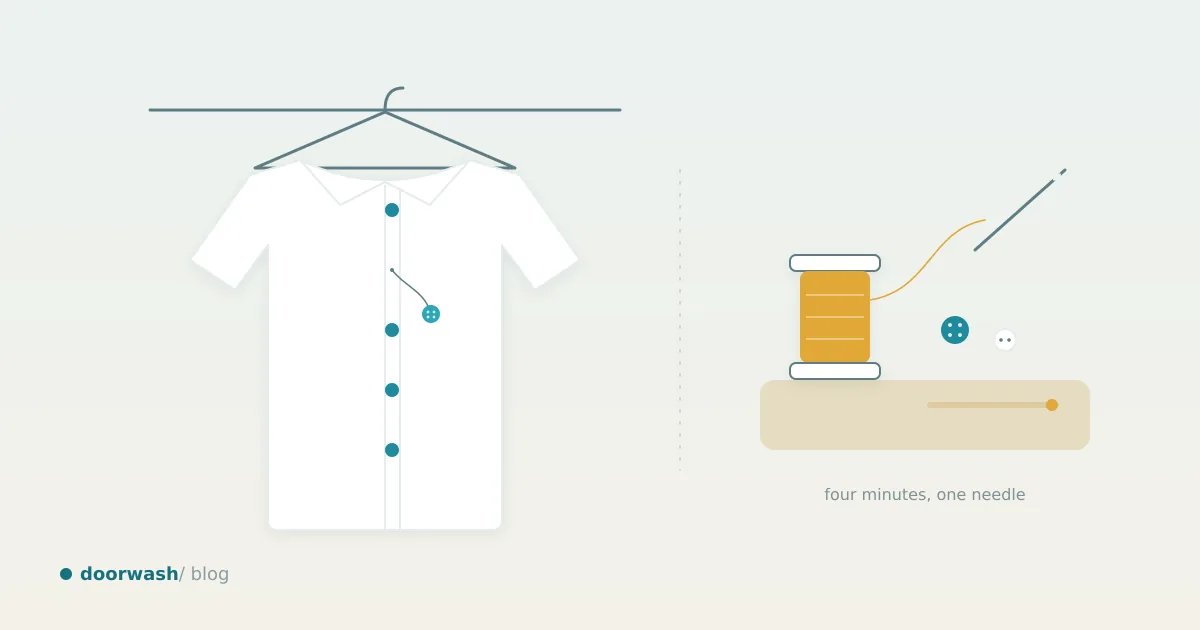
It's Monday morning. You're buttoning your shirt in front of the mirror, and the second button from the top spins. A full turn, then another. It's held on by one thread.
You tell yourself you'll fix it tonight.
You won't. The shirt goes into the wash, and that is where the button is lost.
Why buttons come loose
Look at the back of a button on any ready-made shirt from a mall on Boring Road or a stall in Hathwa Market. Most are sewn by machine in seconds, often with a chain stitch. A chain stitch is one long thread looped through itself. It's fast and cheap to make. Pull one end, and the whole thing unravels like a sack of rice.
So the first stitch that breaks takes the rest with it.
Then there's Patna. Your shirt spends eight months of the year soaked in sweat. Salt from that sweat sits in the thread, and cotton thread weakens when it is salty and wet over and over. Every time you push the button through its hole, the thread rubs against the edge of the hole. Your collar button gets this twice a day. Your cuff buttons get it every time you roll your sleeves up on a hot afternoon.
The thread wears through slowly. You only notice at the end, when it spins.
What the wash does to a loose button
A tight button survives a wash without trouble. A loose one doesn't.
In a washing machine, the drum turns your clothes over hundreds of times. A button on a long thread swings free. It catches on a jeans zip, a hook, another button. One tug, and it's gone. Where does it go? Into the drum's holes, into the filter, sometimes into the drain pump, where it rattles for weeks until the pump needs a mechanic.
Washing by hand is no kinder. The brush you scrub your collar with drags straight across the buttons. Beating a shirt on the bathroom floor snaps a weak thread in one blow.
Then the shirt goes on the line on your roof, and the button falls somewhere between your terrace and your neighbour's.
What the iron does
Most shirt buttons are plastic. A hot iron set for cotton is hot enough to soften plastic, and the bhaiya at your gali corner with his coal iron is running even hotter. Press straight over a plastic button and it cracks, warps, or picks up a shiny melted edge. A cracked button cuts its own thread.
Iron around buttons, never over them. For the button side of a shirt, turn it inside out and press on a folded towel. The buttons sink into the towel and the cloth around them lies flat.
The kurta with buttons that come off
Wedding season in Patna starts the week after Chhath. Out come the kurtas and sherwanis with metal stud buttons that unhook from the back.
Take them out before every wash. Every single time.
Metal buttons left in a wet kurta rust, and the rust leaves orange rings on silk and cotton that will not come out. In a machine, they scratch the drum and tear the fabric around the holes. And they fall out, which is how one ends up missing on the morning of the reception.
Keep them in a matchbox or a small steel dabba, in the kurta's pocket of the almirah. When you dress, put them back last.
Sew it back in four minutes
You don't need a tailor for this. You need a needle, thread, and a matchstick.
Find the spare. Most good shirts have a spare button sewn inside the front placket near the bottom, or a small packet on the price tag. If you lost the button, take one from the bottom of the shirt, the one that stays tucked into your trousers. Nobody will see it.
Pull out the old thread. All of it. Loose chain stitch will keep unravelling if you leave any behind.
Double your thread. Thread the needle, pull the ends even, and knot them together. Two strands are twice as strong.
Use the matchstick. Lay it across the top of the button and sew over it. This keeps a little gap between the button and the cloth. A button sewn flat and tight has no room for the other side of the shirt, and it strains its own thread every time you close it.
Copy the other buttons. If they're sewn in two parallel lines, sew yours in two parallel lines. If it's a cross, make a cross. Six or seven passes through each pair of holes is enough.
Wrap the neck. Pull out the matchstick. Bring the needle up between the button and the cloth, and wind the thread around the stitches underneath four or five times. This little stem is called a shank. It's what makes a hand-sewn button outlast the factory one.
Lock it. Push the needle to the back, make three small knots, and cut. If you have clear nail polish, put one drop on the knot.
That's it. That button will now outlive the shirt.
One habit
When you sort your clothes for the wash, run your thumb down the front of every shirt. Turn each button. Check the cuffs.
It takes ten seconds a shirt. A spinning button found on Saturday takes four minutes to fix. A button lost in the wash means a trip to the tailor, a button that doesn't match, and a shirt you stop wearing.
Before you hand a shirt to anyone to wash, us included, check the buttons. Fix the loose one first. Then let the shirt go.