You bought it two days ago. For Raksha Bandhan. You pulled it out of the polybag, cut the tag, and wore it straight to the function.
By evening your neck is itching. A thin red line where the collar sits. The skin under your arms feels hot. You blame the heat.
It was not the heat.
What is actually on a new kurta
A new kurta is not clean. It only looks clean.
Think about where it came from. A factory somewhere far from Patna. It sat in a bale, then a carton, then a truck, then a shelf at Hathwa Market or Maurya Lok for weeks. Nobody washed it once in that whole time.
Three things are sitting in that cloth right now.
First, the dye that never fixed. Cotton and rayon hold colour loosely at the start. Dark kurtas, black, deep maroon, bottle green, carry the most loose dye. It comes off on your skin. It comes off on your sweat.
Second, the finish. Factories coat cloth to make it look crisp and new on the shelf. Sizing to give it that stiff body. Anti-crease resin so it does not wrinkle in the carton. A lot of that resin releases formaldehyde. It is there to stop the cloth going mouldy on a long humid journey. It is not there for your skin.
Third, everyone who touched it before you. The kurta you bought was tried on by other people. Held against other necks. Folded and refolded on the counter. That is normal. It is also a reason to wash it.
Why Patna makes it worse
A dry, cool day, none of this bothers most people. Patna in August is not dry or cool.
You sweat. Sweat wets the cloth. Wet cloth releases the dye and the finish faster. The sweat also sits in the exact places the seams rub. The collar. The armhole. The waistband of the new pajama. That is where the chemicals meet skin that is already warm and open.
The itch is not in your head. Doctors have a name for it. Textile dermatitis. A rash from the dye and the finish in new clothes, worst where cloth rubs a sweaty fold of skin. In this heat it shows up fast.
The pajama is worse than the kurta. That fresh elastic waistband presses a chemical-loaded band right into your stomach all evening. New white vests do it too, quietly, because they sit against you all day.
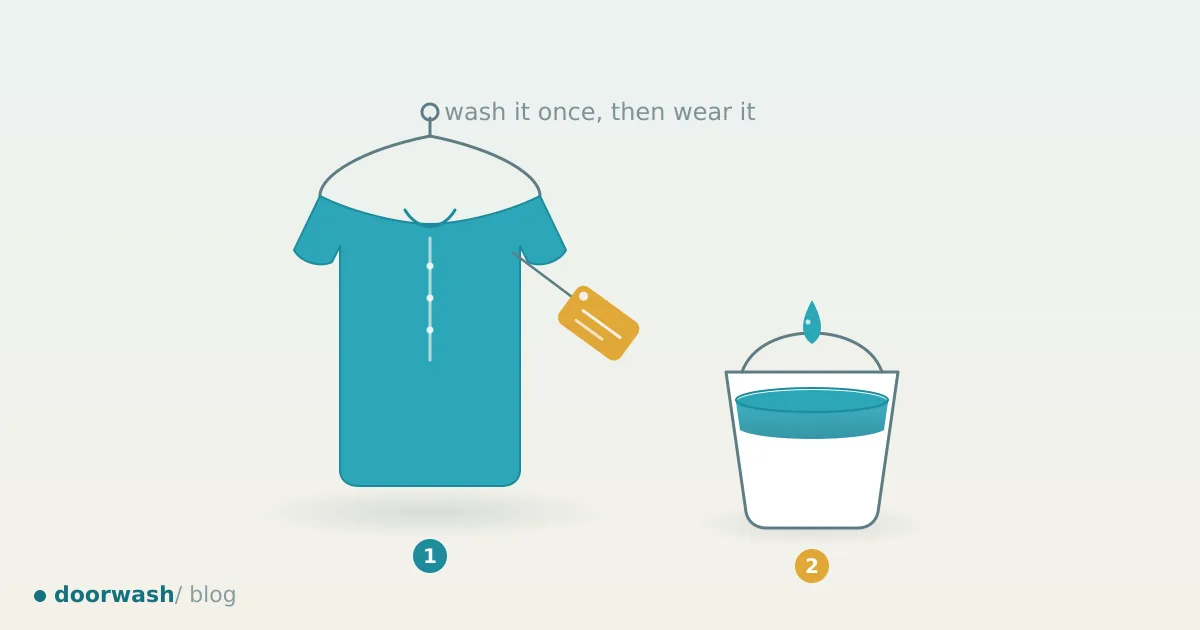
Wash it once. That is the whole fix.
One wash before you wear it. That is it.
Here is how to do it right.
Wash the new kurta on its own the first time, or with clothes of the same colour. Do not put a new maroon kurta in with your white shirts. It will bleed. You know this already from every kurta that ran in the bucket.
Turn it inside out. The dye and the finish sit heaviest on the outer face and the seams. Inside out gets the water to them.
Use plain water on the cooler side and a mild detergent. Hot water can set some dyes. A long rinse matters more than a strong soap here. You are trying to carry the chemicals out, not scrub them in. Give it an extra rinse. Two if it is a dark colour.
For a good festival kurta you are scared to machine wash, soak it fifteen minutes in a bucket of cool water with a little mild detergent, press it gently, rinse it clean, and hang it in shade. Do not wring a new kurta hard. The dye is still loose and hard wringing drives it into the creases.
Then let it dry and wear it. Now it is yours.
The clothes you buy and never wash first
Do a quick count of what you bought this season and put on straight from the packet.
The kurta. The new jeans, stiff with sizing and heavy with indigo that stains your hands blue. The bedsheet still in its plastic. The kids' new clothes for the function. The baby's new cotton set, which is the one that matters most because that skin is the softest in the house.
New does not mean clean. New means untouched by water. Those are not the same thing.
Wash it once first. Your neck already knew that. Now you do too.