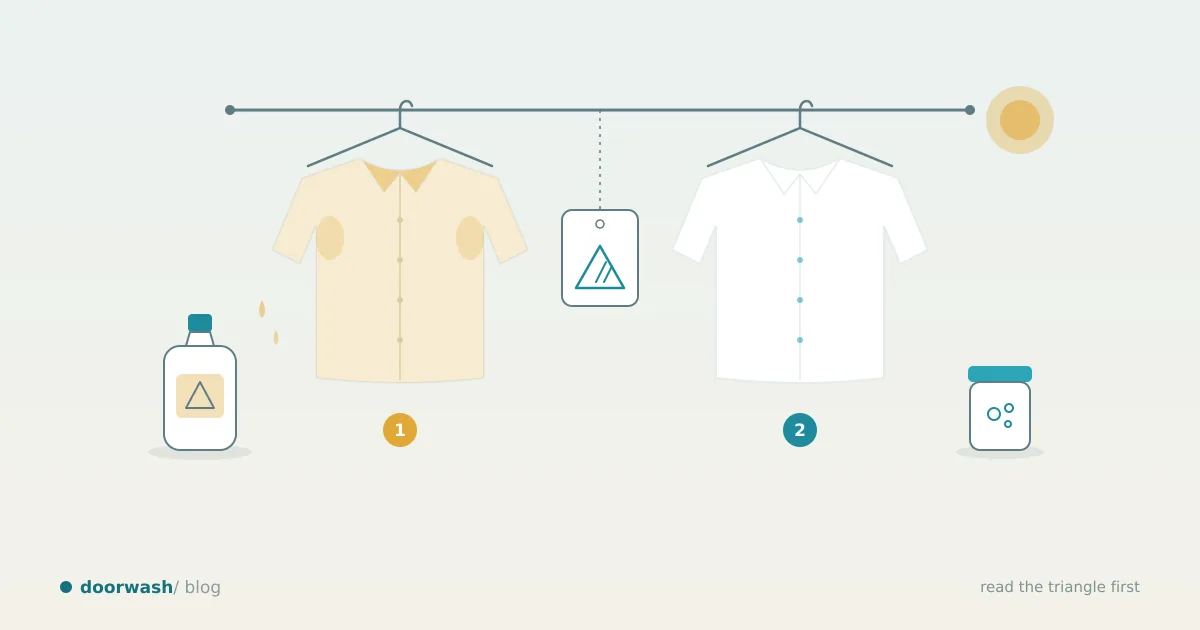
It is the week before Diwali. Every house in Patna is doing safai. Somebody has bought a big bottle of bleach from the kirana shop for the bathroom tiles. And somebody, sooner or later, pours a little into the bucket with the white school shirts.
Next morning the shirts are not white. They are a faint, sad yellow. Worse at the collar. Worse under the arms.
You did not use too little. You used the wrong thing.
What bleach actually does
The bottle in most Patna homes is chlorine bleach. Sodium hypochlorite. It is very good at one job: breaking colour apart. Cotton can take that, in small doses. A lot of other cloth cannot.
Look at the tag on your child's school shirt. Very often it says polyester and cotton. Terricot, as every tailor in Patna calls it. The office shirts that "don't need much ironing" are the same story. Polyester does not get whiter in chlorine. It reacts with it and turns yellow. So does nylon. So does the lycra in leggings and the stretchy waistband of your track pants. Wool and silk go yellow and brittle at once.
That yellow does not wash out. It is a change in the fibre itself. You have dyed the shirt, permanently, with the thing you bought to clean it.
Why the collar goes first
Even on pure cotton, bleach can make yellow worse.
A collar after one day in Patna holds sweat, skin oil, talcum powder, and a film of road dust from the auto ride down Bailey Road. Sweat and skin oil carry proteins and fats. Chlorine reacts with protein and leaves a yellow-brown mark behind. So the dirtiest parts of the shirt, the collar, the cuffs, the armpits, are exactly where bleach does the most damage.
People see that, decide the bleach is weak, and add more. The yellow gets deeper. The cotton gets thinner. A few months later there are tiny holes along the collar fold and everyone blames the dhobi.
The order matters
Bleach is the last step. Never the first.
Get the body oil out before anything else touches the cloth. Wet the collar and underarms. Rub in ordinary detergent or a bar of washing soap. Leave it ten minutes. Scrub with an old toothbrush. Then wash the shirt normally.
Most of the time that is enough. The grey you thought needed bleach was oil holding dirt, and the oil is gone.
If the shirt is pure cotton and still dull, then you can use chlorine bleach. Properly. A capful in a full bucket of cold water. Never poured straight onto the cloth. Thirty minutes, not overnight. Then rinse twice, because bleach left in the fabric keeps working while the shirt dries on the roof.
Use the other bleach
There is a second kind of bleach, and it is the one most homes actually need.
Oxygen bleach. It is sold as a powder, usually with "oxy" somewhere on the pack. The active ingredient is sodium percarbonate. In warm water it releases oxygen, which lifts stains without attacking polyester the way chlorine does. It is safe on most coloured clothes too. Test it on an inside seam first.
Dissolve it in a bucket of warm water. Bath warm, not boiling. Soak the whites for a few hours. Wash as usual. It is slower than chlorine. It is also the one that won't ruin a terricot school shirt three weeks into the session.
Then dry the whites in the sun. Patna gives you a strong one for most of the year. Sunlight on clean, wet cotton is a gentle bleach by itself, and it costs nothing. Keep your darks in the shade.
Read the triangle
Every garment tag has a small triangle on it. It tells you exactly what to do.
An empty triangle means any bleach is fine. A triangle with two slanted lines inside means oxygen bleach only. A triangle with a cross through it means no bleach at all.
Ten seconds of reading. That is the whole method.
Two bottles that should never meet
This part is about safety, and it matters most during Diwali cleaning.
Many toilet cleaners are acid. Pour chlorine bleach into the same mug, or onto a tile still wet with toilet cleaner, and the mix gives off chlorine gas. Bleach with an ammonia glass cleaner does something similar. In a small bathroom with one tiny ventilator and the door shut, that is enough to burn your eyes and your throat within minutes.
Use one product. Rinse the surface completely. Then use the next. Never mix them to make them stronger.
And keep the bleach bottle away from the clothes bucket. Different shelf. Different corner of the house.
The shirt that is already yellow
Be honest about it. If a polyester blend went yellow in chlorine, it is not coming back. Wear it under a sweater this winter, and buy the next one knowing what to do.
If it is pure cotton and the yellow came from sweat, a long oxygen bleach soak can bring much of it back. Sometimes it takes two or three rounds. Then the sun.
From now on, start with the collar, not the bottle.
If you would rather not stand over a bucket at all, book a DoorWash pickup and put the whites in the bag.