Sunday morning. The bucket is full. You lift a wet t-shirt, swing it up over your shoulder, and bring it down on the bathroom tiles. Whack. You do it again. Then you take the brush to the collar and go at it like you mean it.
It feels like work. It feels like the clothes are getting clean.
They are getting shorter lives.
Cloth is thread, and thread is short hair
Hold one of your older t-shirts up to the window. Look at the shoulder, then at the hem. If the shoulder lets more light through, that is not age. You did that.
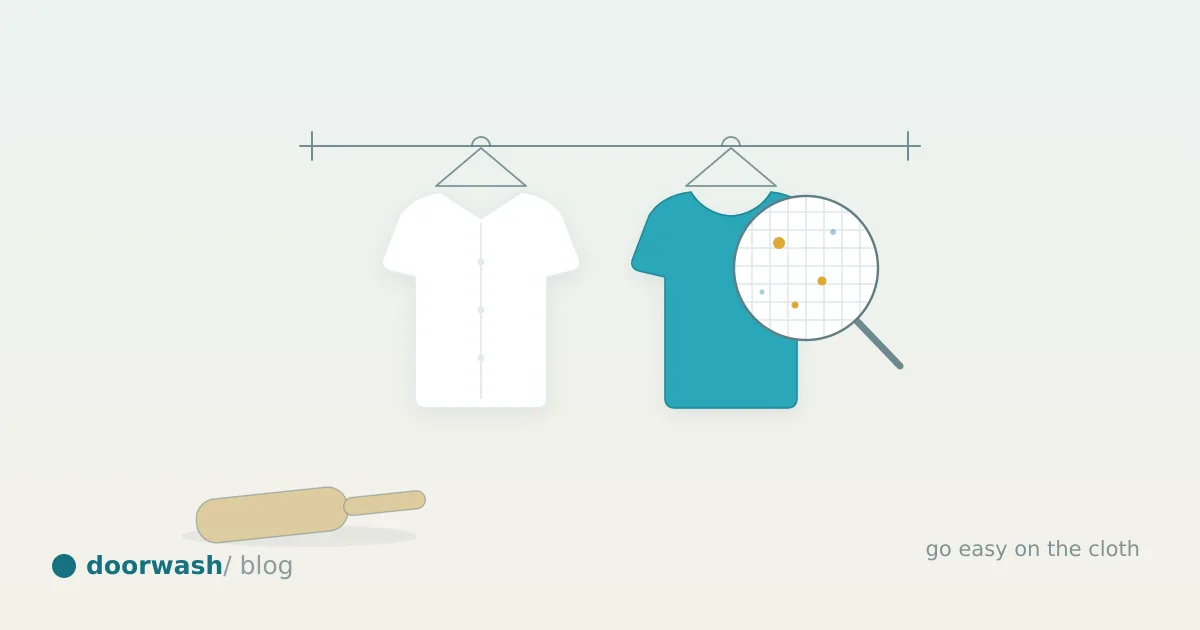
A cotton thread is not one long strand. It is a rope of short fibres, each about an inch long, twisted together. The twist is the only thing holding them in. Rub the cloth hard and you pull fibre ends out of that twist. Keep going and the yarn thins. Keep going longer and the light comes through.
The pulled-out ends do not fall away. They roll against each other and knot into little balls. Those are the bobbles on your chest, under your arms, on the inside of your thighs. On pure cotton the ball eventually snaps off and takes a bit of the shirt with it. On a polyester blend the fibre is too strong to snap, so the ball just sits there forever. That is why your dri-fit tee and your office trouser look furry after four months while your old cotton ganji simply goes see-through.
Nobody sold you a shirt with bobbles on it. The floor made them.
The brush is sanding your collar
Watch what actually happens when you attack a collar with a nylon brush. The mark gets lighter. You decide the brush worked.
It did not lift the stain. It lifted a layer of cotton off the top of the collar. The oil is still down in the fibres where it soaked in. You removed the surface you were looking at.
Nylon bristles are harder than cotton fibre. Every stroke is sandpaper. That is fine on a canvas shoe or a doormat. On a shirt collar that is one millimetre thick, you get about twenty Sundays before the fold goes soft and the edge starts to fray. Then you buy a shirt.
The mark is oil, and oil does not care how hard you hit it
Here is what is on that collar. Sebum from your neck. Hair oil. Dried sweat salts. Dust off Ashok Rajpath. The dark line is oil, and the dust is stuck to the oil.
Oil does not respond to force. It responds to surfactant and time. A detergent molecule has one end that grips grease and one end that grips water. It has to work its way in and get a hold. That takes minutes, not muscle.
Ten minutes of detergent sitting on a wet collar beats two minutes of savage scrubbing, and the shirt is still a shirt afterwards. Ten minutes. Not overnight, and not in a bucket. Just on the collar.
What to do instead
Squeeze. Do not beat, do not twist. Press the water through the cloth with your palms against the side of the bucket. Twisting a wet t-shirt into a rope stretches the knit sideways and never lets it back. That is where the wavy hem comes from.
For the collar and the cuffs, put a little detergent straight on, then rub the cloth against itself. Thumb against thumb, fabric on fabric. Cotton is the right abrasive for cotton. Give it ten minutes, then rinse hard.
Turn t-shirts inside out before they go in the bucket or the machine. Whatever rubbing happens then happens on the inside, where nobody is looking.
Open the buttons before you wash. A closed button gets dragged sideways through the buttonhole all wash long, and the hole tears before the button pops.
Keep the brush for what it is good at. Canvas shoes, the doormat, mud on a chappal, the hem of a jeans. Never on a knit, never on a collar, never on anything you would wear to an interview.
The thapi was made for a different job
The wooden thapi came from washing at a ghat with river water and almost no soap. A thick cotton bedsheet or a durrie can take that. It is heavy, tightly woven, and the beating pushes water through it because nothing else will.
Your jersey-knit t-shirt is two hundred grams of loose loops. Your shirt is fine poplin. They were never in that conversation. Patna heat means you are washing something almost every day, so this is not one bad Sunday. It is three hundred of them a year, on the same twelve clothes.
The arithmetic
Two men buy the same shirt from Hathwa Market on the same day. One squeezes. One beats. In two years the first man still wears his to work, and the second one has bought three more.
Same shirt. Same water. Same soap. The difference is the tiles.
If you would rather not think about any of this on a Sunday morning, that is exactly what we do. We wash by fabric, not by force, and it comes back to your door folded. Either way, put the thapi down.