Sunday. The mutton is on the stove. You lean over the kadhai to check the salt, and a drop of yellow gravy jumps onto your white kurta. You do what everyone does. You wet a cloth, rub some detergent on the spot, and scrub.
The yellow turns orange. Then red. Now it looks worse than when you started.
You did not ruin the kurta. You just walked into the strangest thing in your kitchen.
Haldi is not a normal stain
Most stains are dirt sitting on cloth. You lift the dirt, the stain goes. Haldi does not work like that.
The colour in turmeric comes from a chemical called curcumin. Curcumin is a natural pH indicator. It changes colour depending on what it touches. In plain water it stays yellow. Touch it with anything alkaline, and it flips to a deep red-brown.
Your detergent is alkaline. Almost every washing powder in Patna is. So the second your soap hit the haldi, the yellow did not spread. It reacted. That red mark is chemistry, not a bigger stain.
Here is the good news hiding inside that. The red is reversible. Rinse the soap out with plenty of plain water, and it goes back to yellow. You have not lost anything. You have just learned to stop putting soap on it first.
What to do at the kadhai, right away
The first ten minutes decide everything. Move fast, and gently.
- Do not reach for soap. Not yet.
- Scrape the thick gravy off with the back of a spoon. Do not rub it in.
- Turn the fabric inside out. Hold the back of the stain under a running cold tap. Push the colour out the way it came in, not deeper through the weave.
- Keep the water cold. Hot water cooks the stain in and sets it.
Do this and most of a fresh haldi splash leaves before it ever becomes a fight.
The Patna sun is on your side this time
Now the part nobody tells you.
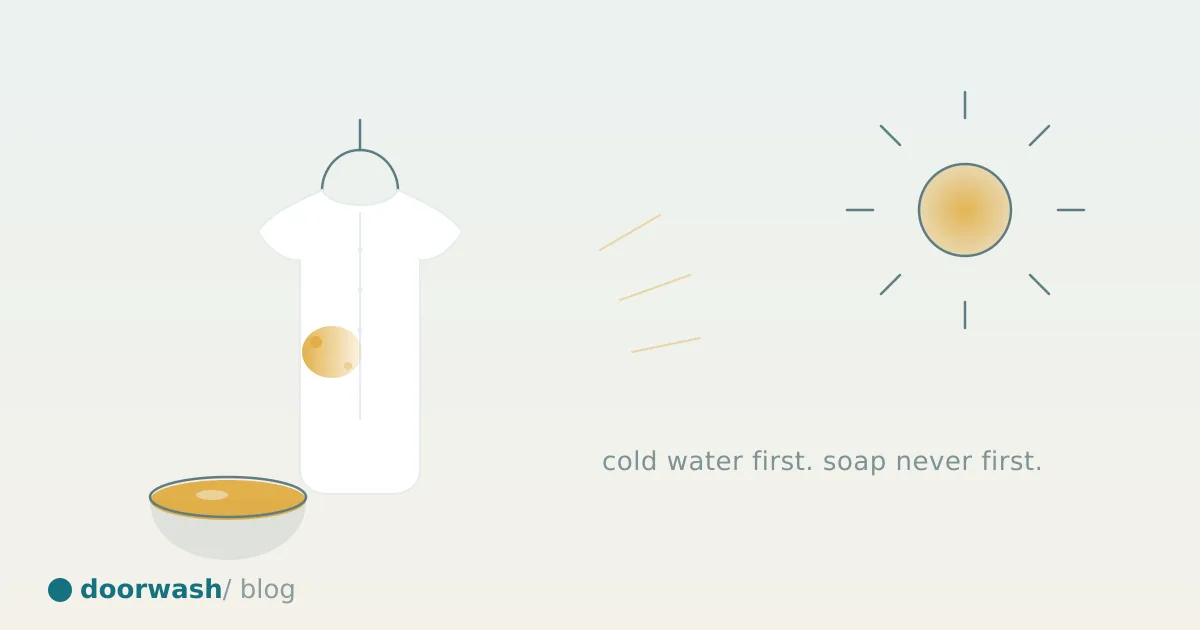
Curcumin breaks down in sunlight. The UV in strong sun tears the molecule apart. A haldi mark you cannot fully wash out, you can fade with light.
So after you rinse, hang the garment wet and stretched out in direct sun. Two, three hours on the terrace in a Patna afternoon, and the leftover yellow keeps lifting on its own. Wet cloth plus hard sun. This is the one time the brutal sun that fades all your other clothes is working for you instead of against you.
One warning. Do this on the wet, freshly rinsed stain. If you let a soapy red mark dry hard first and then throw it in the sun, you are baking the reaction in, not undoing it.
Gravy haldi is worse than dry haldi
Dry haldi off a spice box brushes away. The haldi in your Sunday gravy is different. It comes wrapped in oil. The oil glues the colour to the fibre and blocks water from reaching it.
For that kind, water alone loses. Put a little dishwashing liquid, the kind you use on utensils, straight on the spot. Work it in with your fingers. Give it a few minutes to cut the oil. Then rinse cold, then sun. The dish soap handles the grease so the water and light can reach the colour underneath.
The haldi ceremony leaves the deepest marks
It is wedding season in Patna. Somewhere in your family this month, someone is sitting still while relatives smear fistfuls of haldi paste on their face and arms, and everyone laughs, and yellow flies onto every kurta and saree in the room.
That paste is haldi, oil, and often besan, pressed hard into cloth and left there for hours while the photos happen. By the time anyone thinks about the clothes, it is night and the stain is set.
Do not scrub those in a panic that night. Rinse cold, treat the oil with dish soap, and let the sun do its slow work over the next two mornings. The colour drops a shade each day.
The clothes you should not experiment on
Your cotton kurta can take cold water and sun. Your Banarasi saree and your silk sherwani cannot. Silk, wool, and anything with real zari will not survive the tap-and-terrace routine, and a red haldi mark on silk is a job for a professional, not for your bucket.
If it is a garment you would be sad to lose, keep your hands off it and send it out. A stain you can see is fixable. A silk saree you rubbed raw at 11 at night is not.
That is the whole trick with haldi. Cold water first, soap never first, and let the Patna sun finish the job.