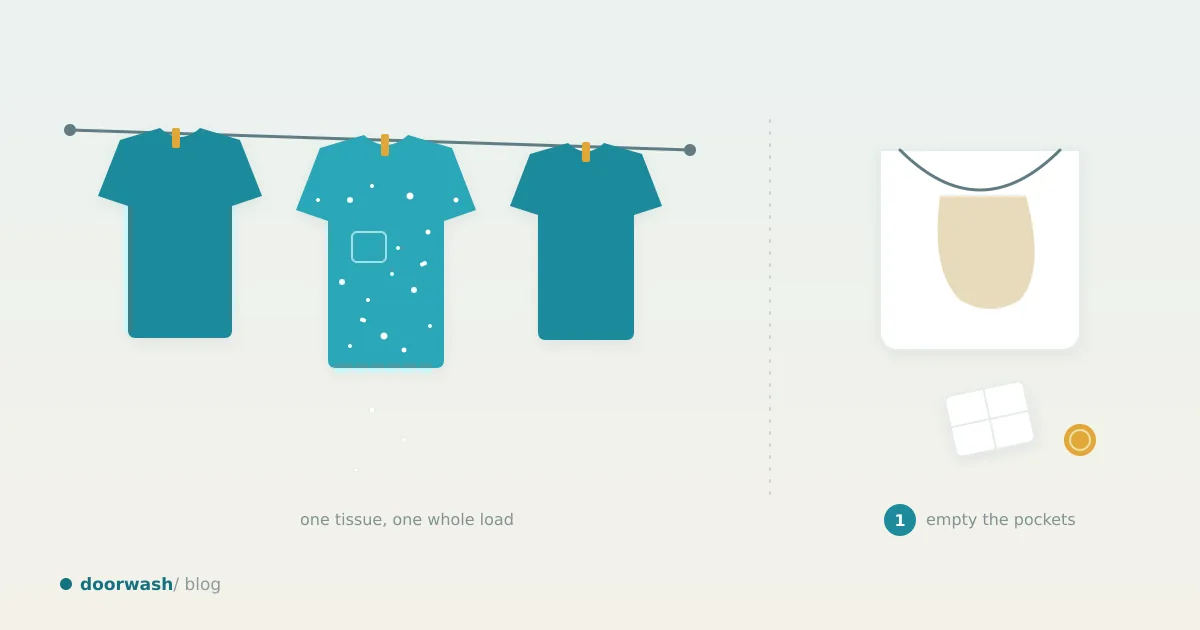
You open the machine on Sunday morning. Everything is covered in white flecks. Your black trousers. Your navy kurta. Your daughter's school sweater. It looks like it snowed inside the drum.
Somewhere in that load was one tissue.
Maybe it was the napkin from the chaat stall on Boring Road. Maybe it was the one you grabbed at a wedding buffet last week and folded into your shirt pocket. It doesn't matter now. One small square of paper has become ten thousand small pieces of paper, and they are on everything you own.
Here is why it happens, how to fix it, and how to make sure it never happens again.
Why one tissue goes so far
A tissue is made of short wood fibres, pressed loosely together. Dry, it holds. Wet, it gives up almost immediately. That's the point of a tissue. It's designed to fall apart so you can flush it.
Put it in a washing machine and it gets forty minutes of water, soap and tumbling. It doesn't tear into a few pieces. It breaks down into individual fibres, and those fibres spread through the water to every garment in the drum.
Then the spin cycle presses them into the cloth. Wet paper fibre clings to wet fabric. When the clothes dry, the fibres dry in place. Cotton holds them. Wool grabs them. Fleece and sweaters are the worst, because the surface is all loose loops.
And you see them most on dark clothes. Black, navy, maroon. A white shirt hides paper lint. A black pant shows every speck.
Bucket washing doesn't save you either. If you soak clothes overnight in a bucket with a tissue in one pocket, the tissue dissolves slowly all night. By morning, it's in the water. You'll find it on everything you wring out.
Don't wash it again
This is the first thing everyone does. They see the flecks and put the whole load back in for another cycle.
Stop. A second wash spreads the mess. The fibres are already loose in the clothes. More water picks them up and puts them down somewhere new. You'll take out the same load with the flecks in different places.
Paper lint comes off dry. So let it dry first.
Getting it off
Dry everything completely. Hang the clothes on the line like normal. In October in Patna, a few hours on the terrace is enough for most cotton. Don't try to brush wet paper off wet cloth. It smears and sinks in deeper.
Shake each piece hard. Outside, over the balcony or on the terrace. Hold a shirt by the shoulders and snap it. Hold trousers by the waist and do the same. A surprising amount falls off right here. Do this before you bring anything back inside, or you'll be sweeping paper off your floor for a week.
Use tape on what's left. Lint rollers work well. If you don't have one, wrap packing tape around your hand with the sticky side out and pat the cloth. Don't rub. Pat. Do the dark clothes first, since that's where it shows.
Run a damp hand over sweaters. For woollens and anything fluffy, tape can pull at the fibres. Wet your palm a little, wring it, and stroke down the sweater in one direction. The paper rolls up into small balls you can pick off.
Clean the machine. Many front-loaders and some top-loaders have a lint filter. Open it. It'll be full of grey paper mush. Wipe the drum and the rubber seal with a dry cloth too. If you skip this, the leftover fibre ends up on your next load, and you'll blame a tissue that isn't there.
Only after all of this, if a garment still looks dusty, rinse it on its own in plain water. One garment. No soap.
What else is in your pockets
Tissue is the worst offender, but it has company.
The ATM slip from the SBI branch on Fraser Road. A bill from Hathwa Market. An auto driver's change, two coins and a folded ten. A train ticket from your trip home. A Paytm QR sticker someone handed you. Each of these behaves like tissue, or worse.
Thermal receipts go grey and sticky. Coins knock against the drum and chip the inside of the machine over time. Keys catch on delicate fabric and pull threads. And notes, folded twice and forgotten, come out as pulp. A ten-rupee note survives better than most paper, but not every time.
Every piece of paper you carry is waiting for a wash.
The habit that ends this
Check every pocket before anything goes in the bucket or the machine.
That's it. Ten seconds per garment.
Turn trouser pockets inside out. Feel the shirt pocket. Check the small coin pocket inside your jeans, because that's where folded tissue hides. Squeeze the kurta side pockets. Look inside your jacket. Winter jackets have three or four pockets, and you'll be pulling them out of the almirah any day now.
Do it at the moment you take clothes off, too. Empty your pockets onto the same table every night. Keys, wallet, receipts, the tissue. Then the clothes go into the laundry pile already empty, and Sunday has one less thing to go wrong.
Teach your kids the same. A school uniform pocket is a museum of chewed rubber, pencil shavings and paper boats.
The real cost
One forgotten tissue costs you a whole Sunday morning. You shake, you tape, you pick flecks off a black shirt one by one while your tea gets cold.
Wedding season is about to start. You're going to fold a lot of napkins into a lot of pockets in the next two months. Empty them.
And when you send your clothes to DoorWash, our team checks every pocket before the wash. Every one. We find tissues, coins, earphones, rings and, once, a passport. We put it all in a small bag and send it back with your clothes.
But check anyway. It's your pocket.