Take out the white kurta you keep for functions. Hold it flat against a fresh sheet of A4 paper in daylight.
The paper is white. The kurta is not.
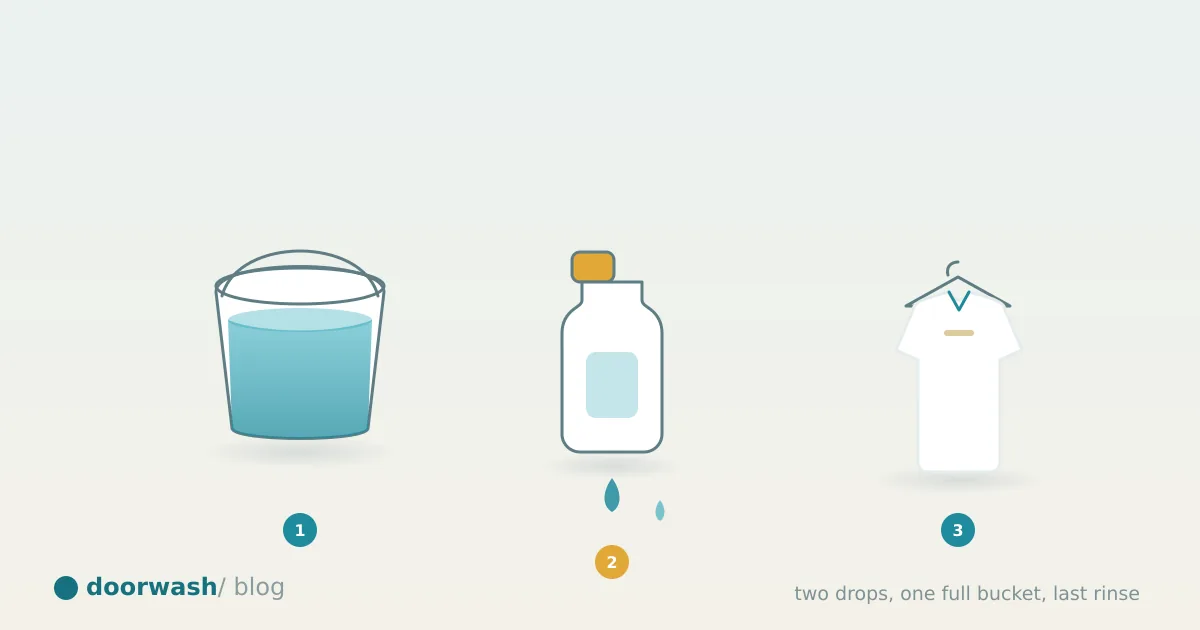
So you do what your mother did and her mother did. Two drops of blue in the last bucket. The water goes the colour of a winter sky, the kurta goes in, and what comes out looks new again.
Nothing was cleaned. Something was painted.
Blue cancels yellow
Old cotton reflects a little extra yellow light. That is what "dull" means. Your eye is very good at catching it, especially next to a genuinely white thing like paper or a new pillow cover.
Blue sits opposite yellow. Lay a whisper of blue over the cloth and the yellow gets cancelled out. The eye stops seeing a tint and starts seeing white.
Here is the part nobody tells you. The cloth is now reflecting less light than before, not more. You subtracted the yellow instead of removing it. The shirt is measurably darker and it looks brighter. That is the whole trick, and it has been sold in kirana shops in Patna for eighty years.
Nothing wrong with the trick. Just know what you bought.
The cube and the drops are not the same thing
The hard blue cube is ultramarine pigment. Tiny solid particles. They do not bond to cotton. They sit on the fibre, they come off in the next wash, and if a grain does not dissolve it lands on your shirt as a full-strength blue speck.
The liquid drops are different. That is a fluorescent whitener. It grabs ultraviolet light, which your eye cannot see, and throws it back as visible blue. Under the open sky on your terrace it works hard. Under a tube light at night it does almost nothing, which is why the shirt that looked brilliant on the line looks ordinary at the wedding.
Both are cosmetics. Neither one touches the sweat in your collar.
Where it goes wrong on a Patna terrace
Four ways, and I have seen all four.
You pour the drops onto the cloth. Straight from the bottle onto a wet white shirt lying in the tub. That is not two drops in twenty litres, that is neat dye on one square inch. You get a blue patch with a hard edge that no amount of Surf will argue with.
You use half a cube in a small bucket. The powder never fully dissolves in cold Patna tap water. The undissolved grit settles at the bottom, and the last garment you push down gets a rash of blue dots.
You keep adding it, every wash, for a year. Pigment builds up where cloth is thickest. Collars, cuffs, the double layer at the placket. Look at an old school shirt in September and you will see the collar has gone a flat grey-blue while the back is still cream. Nobody notices it happening. Everybody notices it after.
You use it on a polyester blend. Half the white shirts sold on Ashok Rajpath are cotton-poly. Polyester takes blue unevenly and holds it. Cotton lets it go. Wash a blended shirt with neel for six months and the two fibres end up at two different shades in the same piece of cloth.
How to actually use it
Last rinse only. Clean water, no soap left in it, because detergent and pigment fight and the pigment loses in patches.
Dissolve first. Always. Make the blue in a mug of warm water, stir until there is not one grain left, then pour that into the bucket. If you are using drops, two is plenty for a full bucket. Three if the bucket is huge.
The water should look like weak ink, not like Holi. If you cannot see your hand at the bottom of the bucket, you have used far too much.
Now put the garment in fully submerged, move it around for twenty seconds, lift it out. Do not let it rest on the floor of the tub where the heavy stuff settles. Do not wring it in the blue water.
Dry in shade. Hard afternoon sun in Patna breaks down the fluorescent whitener within a few hours, and it breaks it down unevenly, so the shoulders that faced the sun end up a different white from the front.
Fix the yellow instead
Neel is a cover. If you want the shirt to be white, take the yellow out.
Most yellowing in a Patna wardrobe is sweat protein and body oil that a cold bucket wash never lifted, then baked in by the sun and the iron. Oxygen bleach handles it. Sodium percarbonate, sold as a whitening powder, one scoop in warm water, warm enough for your hand and no hotter. Let the shirt sit thirty to forty minutes. Then a normal wash.
If the yellow is more of a rusty cream and it showed up across the whole garment at once, that is the iron in your borewell water and oxygen bleach will not touch it. Different problem, different fix.
Do this once and the shirt is genuinely white. Then, if you like, add your two drops on top. Now the blue is doing what it is good at, which is polishing something that is already clean.
If you already have a blue patch
Work while it is wet. Turn the garment inside out, hold the back of the patch under a running tap, and let the water push the pigment out the way it came in. Do not rub from the front.
Then wash with detergent, on its own, in plenty of water. Ultramarine on cotton usually gives up in two washes. Fluorescent whitener is more stubborn and takes a few.
Whatever you do, do not iron it before it is out. Heat is what makes a temporary mark permanent, and the iron is very good at its job.
Or hand us the whites and stop thinking about it. We wash by fabric, we rinse properly, and the blue bottle stays on the shelf where it belongs.